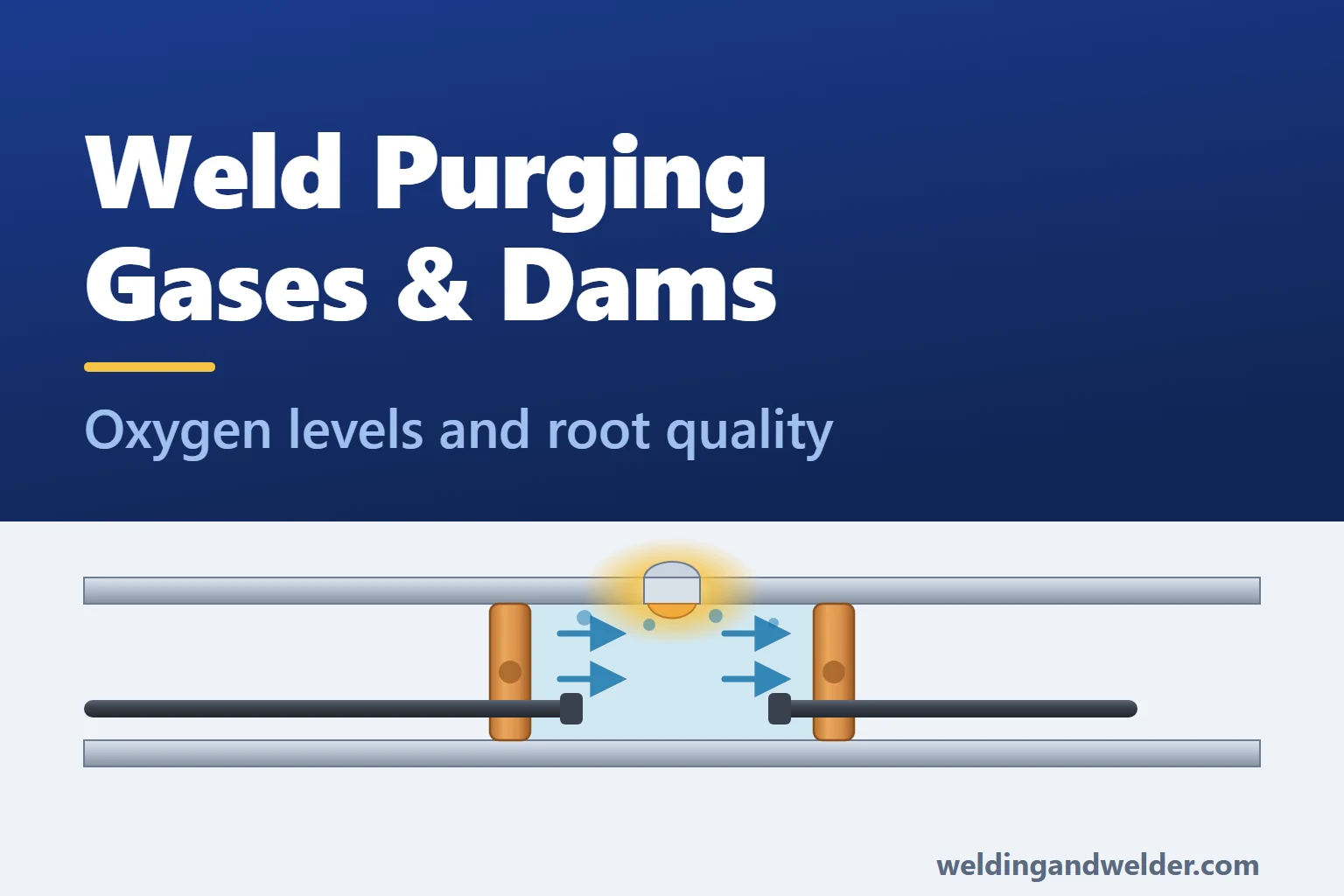
Weld purging protects the back of a joint by replacing the air around it with a suitable gas, usually argon. This helps prevent oxidation while the weld is molten and as it cools. On stainless steel, an unprotected root can develop the rough, dark oxide known as sugaring, which damages its surface and corrosion resistance. Other sensitive metals, including nickel alloys and titanium, also need protection from the atmosphere. Once a pipe joint is complete, repairing a badly oxidised root can be difficult and may mean removing the weld.
A reliable purge starts with the gas specified for the material, but the setup matters just as much. Keeping the space small, giving the air a clear way out and measuring the oxygen level all help you reach the required conditions without using more gas or time than necessary.
Our weld purging equipment range includes purge monitors, inflatable systems, water-soluble dams and double-seal systems from Argweld, Aquasol and PPM. The sections below explain where each type fits into the setup.
In this guide:
What Is Weld Purging?
Purging protects the underside of a weld by replacing the surrounding air with a gas suited to the material. The torch shields the face of the weld, while the purge protects the root on the other side, where the torch gas may not reach.
You may also see this described as back purging or, on pipework, an internal purge. In this guide, the terms refer to the same task: protecting the back of the joint during welding and cooling.
On pipework, the root is the surface that comes into contact with whatever the pipe carries. Oxidation or a rough finish can affect corrosion resistance and cleanliness, yet the bore may be difficult to reach for inspection or repair once the joint is complete. Taking care over the purge at the start can therefore avoid substantial rework later.
- Helps prevent sugaring by keeping oxygen away from the hot stainless root.
- Protects corrosion resistance by limiting the oxidation that can leave a chromium-depleted layer beneath the surface of stainless steel.
- Helps keep the bore smooth, reducing rough areas and crevices that can retain contamination in hygienic, pharmaceutical and process pipework.
- Reduces the need for post-weld cleaning, which is particularly useful where the bore is difficult to reach. Any cleaning required by the specification still applies.
When Do You Need to Purge?
The need for a purge depends on the material, the welding process and the condition required inside the finished joint. The table below gives a starting point for checking the job requirements.
| Material | Purge? | Why |
|---|---|---|
| Austenitic stainless (304, 316) | Normally for exposed roots where oxidation must be controlled | Root oxidation can cause sugaring and reduce corrosion resistance |
| Duplex and super duplex | Normally for gas-shielded roots exposed to air | Root protection and gas choice matter for corrosion resistance and weld-metal phase balance |
| Nickel alloys | Normally for exposed gas-shielded roots | Root oxidation must be controlled to meet the alloy and service requirements |
| Titanium and zirconium | Yes, with stringent atmospheric protection | Hot metal can absorb oxygen and nitrogen and become embrittled; protection must continue during cooling |
| Copper-nickel | Often; check the procedure | Root condition is important in marine and other process systems |
| Carbon and low alloy steel | Not normally for ordinary carbon steel; check alloy and service requirements | Some low-alloy grades and critical or high-purity applications need root protection |
| Aluminium | Not routine on every job; required for some joints | Backing gas may be specified for root quality. AC cleaning at the arc does not shield the underside |
Use the job specification to make the final decision. Hygienic, pharmaceutical, semiconductor and other high-purity systems may set stricter limits for oxygen, root appearance and cleanliness than general fabrication.
Which Purge Gas
| Gas | Used for | Notes |
|---|---|---|
| Argon | A common choice for many materials | Inert and widely available. Its higher density than air helps with bottom-to-top displacement purging |
| Argon with a nitrogen addition | Some duplex and super duplex procedures | Nitrogen can help retain the required phase balance. Use the gas composition specified for the grade and procedure |
| Nitrogen, or nitrogen with hydrogen | Suitable stainless grades, as permitted by the procedure | Nitrogen can be suitable for austenitic and duplex steels. Hydrogen-containing mixtures have different restrictions and should not be assumed suitable for duplex or other hydrogen-sensitive grades |
| Helium | Specialist applications | Lighter than air, so displacement purging generally uses a high inlet and low vent |
Keep carbon dioxide and compressed air out of this type of purge. Carbon dioxide is used in MAG shielding, but it is reactive and unsuitable for protecting an oxidation-sensitive root. Compressed air introduces the oxygen you are trying to remove, so check the gas supply carefully where several lines meet at a manifold.
The gas must stay clean and dry all the way to the joint. Use the specified welding-grade supply and suitable dedicated hoses, as moisture, leaks or permeation through unsuitable hose can spoil the purge. If the oxygen reading remains too high, check the supply line and connections as well as the joint seals and dams.
Purge Volume, Not Purge Time
The volume you need to purge gives you a useful estimate of gas use and waiting time. The five to seven volume changes often used as a rough planning allowance are not proof that the joint is ready to weld. Mixing, leaks and trapped air can increase the amount needed, so use the oxygen reading to confirm that you have reached the specified limit.
Working Out the Volume
For a pipe, calculate the internal volume from the bore area multiplied by the length, then convert it to litres. A 100 mm bore over 6 metres holds about 47 litres, whereas dams placed 150 mm either side of the joint reduce that space to about 2.4 litres. The dam positions must still meet the product’s heat-clearance requirements.
| Pipe bore | Volume per metre | Volume in a 300 mm dammed section |
|---|---|---|
| 25 mm | 0.5 litres | 0.15 litres |
| 50 mm | 2.0 litres | 0.6 litres |
| 100 mm | 7.9 litres | 2.4 litres |
| 150 mm | 17.7 litres | 5.3 litres |
| 300 mm | 70.7 litres | 21.2 litres |
The saving becomes even more useful as the pipe gets larger. On a 300 mm bore, a dammed section contains about twenty litres instead of the several hundred litres in a long pipe run. That is the space to fill, rather than the total gas you will use, which also depends on the number of volume changes and the flow maintained during welding.
Dams and Sealing the Zone
| Type | How it works | Best for |
|---|---|---|
| Water-soluble dams | Paper or film dams that seal the bore and are later dissolved and flushed out with a suitable aqueous solution or steam | Joints where retrieval is difficult, provided the system permits the required flushing and cleanliness checks |
| Inflatable purge systems | Inflatable dams seal either side of the joint, with purge gas supplied to the space between them | Repeated work within the system’s size range and temperature rating |
| Double-seal systems | Sealing units joined by a rigid or flexible connector to enclose the weld area | Work suited to the model’s bore range and heat rating; double seals alone do not establish high-temperature suitability |
| Foam or card dams | Temporary dams cut to fit and sealed in place | Only where the material, cleanliness and heat limits permit; the dams must be retrievable |
| Tape alone | Suitable aluminium purge tape seals open ends or the root gap while leaving a controlled vent | Small enclosed volumes and gap sealing; dams are usually more economical on long pipe runs |
Sealing the Root Gap
An open root gap lets purge gas escape, so suitable aluminium purge tape can help seal it while you prepare the joint. Peel the tape back just ahead of the arc as you weld, keeping the adhesive away from the hot joint. Use tape or film intended for welding and follow its temperature limits.
- Avoid ordinary duct tape or masking tape near the weld. Heat can break down the adhesive and introduce contamination into the joint.
- Seal unwanted openings, including branches, valve openings, flange faces and instrument tappings, while leaving the intended purge vent clear.
- Account for every dam you install. Retrieve reusable dams and follow the specified flushing method for soluble ones, so material is not left in the line.
You can compare pre-formed water-soluble purge dams, inflatable purge systems and double-seal purging systems according to the pipe size, access and temperature involved.
Setting Up the Purge
Argon Is Heavier Than Air
Argon’s density helps you choose the inlet and vent positions. At the same temperature and pressure, it is around 1.4 times as dense as air, so feeding it low and venting high can help displace the air. The gases still mix, especially with a strong inlet jet or an awkward pipe layout, which is why the oxygen reading matters more than the arrangement alone.
- Feed argon into the lower part of the purge space so the flow can help displace air upwards.
- Provide a vent at the top to let displaced air and excess gas leave the space.
- Check the route the gas will take. An inlet and outlet that allow gas to bypass the joint can leave pockets of air, even when gas is flowing freely.
- Allow for helium’s lower density if it is specified: a high inlet and low vent are generally used for displacement purging with helium.
Flow and Pressure
- Introduce the gas with a controlled flow. A strong jet can mix the purge gas with air and disturb the weld area. A suitable diffuser helps spread the flow.
- Reduce to the required welding flow once the purge is established. Keep enough gas moving to maintain the oxygen limit as gas escapes through the vent and open joint.
- Keep the pressure low. Excess pressure inside the pipe can push the molten root outwards towards the torch, leaving a concave root surface or, in severe cases, blowing through the pool.
- Keep a vent open throughout the purge. Gas entering a sealed space will build pressure, so check that the outlet remains clear as the joint closes.
Sequence
- Clean and dry the joint inside and out. Oil, moisture and other contamination in the bore can affect the weld even when the oxygen reading is low.
- Fit the dams to create a small purge space while keeping the distance from the weld required by their temperature rating and instructions.
- Seal the root gap and other unwanted openings, leaving the vent clear.
- Start the purge at a suitable flow and use the volume calculation as an estimate of the initial gas requirement.
- Confirm that the oxygen reading meets the procedure before striking an arc, allowing for the monitor’s sampling and response time.
- Maintain the purge while tacking so the tacks receive the same root protection as the weld.
- Keep the purge running through the required weld passes. This commonly includes the root and hot pass; the procedure may require protection for longer.
- Continue the purge through the specified cooling period. Titanium and other reactive metals need protection while they remain hot enough to absorb gases from the atmosphere; the absence of a visible glow is not a reliable stopping point.
Measuring the Oxygen Level
A suitable purge monitor tells you when the atmosphere is ready for welding. Rather than relying on a fixed waiting time, you can check that the oxygen level meets the procedure and stays within its limit while you work. Choose an instrument with the range and accuracy needed for that limit.
- Take a sample that represents the atmosphere at the joint. Depending on the system, this may be from a probe near the weld or a designated exhaust sampling connection. Follow the equipment instructions and prevent room air from entering the sample.
- Use a trace oxygen monitor with suitable ppm accuracy. A personal oxygen-depletion alarm serves a different purpose and is not a substitute for measuring the low oxygen levels used in purging.
- Watch how the reading changes. If it stays above the required limit, check for leaks, trapped air, inadequate gas distribution and sampling or sensor problems.
- Check calibration and sensor condition as the manufacturer specifies, including any required calibration checks or sensor replacement.
- Record the oxygen reading when the job requires evidence that the specified purge conditions were achieved.
Our weld purge monitors and replacement sensors range covers instruments and spares for checking the purge.
Reading the Root
The colour and texture on the underside of a stainless weld can help you judge how well it was protected. They are useful clues, but colour also changes with temperature, time and surface condition, so it cannot tell you the exact oxygen level or decide acceptance on its own.
- Bright silver or very light straw usually indicates little visible oxidation. Check the specified finish and cleanliness requirements before accepting it.
- Straw to bronze shows heat tint, which may need removal where corrosion resistance or hygienic service is important. Acceptance depends on the job specification.
- Blue to grey suggests more pronounced oxidation and possible chromium depletion beneath the surface. Check the applicable acceptance and cleaning requirements.
- A rough, crystalline root is characteristic of sugaring. It needs assessment against the acceptance criteria, and severe oxidation may require removal and repair of the weld rather than surface cleaning.
Where the bore is difficult to see, inspecting an early joint with a borescope can reveal a problem before it is repeated across the rest of the run. Use that check alongside the inspection requirements for the job.
For more on root oxidation and its causes, see sugaring in our TIG welding defects guide.
Alternatives to Purging
A full gas purge may be difficult on a large vessel, an open structure or a joint that cannot easily be sealed. The options below can help in suitable applications, but the welding procedure must allow the chosen method and it must achieve the required root quality.
- Ceramic backing tape supports and shapes the root on suitable open joints, but does not automatically provide the atmospheric protection a sensitive alloy needs. Check its use against the welding procedure; our weld backing and ceramic tapes range covers the available backing products.
- Backing flux can protect the reverse of a suitable joint where gas purging is impractical. It must be approved for the material and service, with the required residue removal planned before welding.
- Consumable insert rings help control the root profile on pipework. They are often used with a purge and should not be treated as a substitute for it.
- Welding from both sides may allow the root to be removed by back gouging and the reverse welded, where access and the approved procedure permit this.
- A different root-welding process may be suitable if it can achieve the required internal finish and properties without a gas purge. This is a procedure choice to confirm before starting the job.
Troubleshooting
| Symptom | Likely cause | What to do |
|---|---|---|
| Oxygen reading will not come down | Leaks, trapped air, unsuitable hose, poor gas distribution or a sampling problem | Check seals, branches, hoses and the monitor setup. Use an approved leak-detection fluid on fittings |
| Reading falls then rises again | A disturbed seal, changing flow, an obstructed vent or air entering the sample | Check the dams, gas supply, vent and sampling line before continuing |
| Root sugared despite a good reading | Protection lost during welding or cooling, or a sample that did not represent the joint | Check the sample point and maintain the purge for all passes and cooling time required by the procedure |
| Root blown out or concave | Excess purge pressure is one possible cause; welding settings and fit-up can also affect the profile | Check the flow and vent first, then review fit-up and welding settings if the problem remains |
| Root wanders or is inconsistent | A gas jet disturbing the pool, or variation in fit-up or welding technique | Check gas distribution and use a suitable diffuser; review joint preparation and technique as well |
| Purge takes far too long | A large purge volume, poor distribution, trapped air or leakage | Reduce the enclosed volume where possible, keeping the required heat clearance around dams |
| Porosity in the root | Moisture or contamination in the bore, gas supply or hoses | Clean and dry the joint, check hoses and fittings, and confirm gas quality |
Safety: Argon Is an Asphyxiant
Argon, helium and nitrogen are non-flammable, but all can displace the oxygen needed for breathing. You cannot see or smell these gases, and an oxygen-deficient atmosphere can cause collapse without warning. Argon can also collect in low points, so the hazard may extend beyond the area where the welding is taking place.
- Plan for the confined-space hazard around purged vessels, tanks and large pipes. Keep your head out of the opening. Avoid entry wherever possible; where entry is necessary, use a safe system of work covering isolation, ventilation, atmospheric testing and rescue.
- Check pits, trenches, sumps and other low points. Argon can remain there after the purge stops, so use the required ventilation and atmospheric checks before access.
- Shut off the gas supply when work is finished. A purge left flowing in an enclosed area can create an oxygen-deficient atmosphere for the next person who enters.
- Provide suitable ventilation around the work area and discharge purge gas safely, especially when purging large volumes or working in a small room.
- Secure cylinders upright and protect them from heat and damage. Use the appropriate trolley for moving them and fit valve protection where supplied and required.
- Check the safety data for hydrogen-containing mixtures. Their flammability classification depends on the composition, so follow the supplier’s handling and venting instructions for the actual gas being used.
Weld Purging FAQ
What is purging in welding?
Purging replaces the air at the back of a weld with a suitable gas, usually argon, to limit oxidation during welding and cooling. The torch protects the face of the weld, while the purge protects the root on the other side. It is also called back purging and is widely used when welding stainless steel and other materials that need protection from the atmosphere.
How long should you purge before welding?
Purge time depends on the enclosed volume, gas flow, mixing and leaks, as well as the oxygen limit you need to reach. Five to seven volume changes can be a rough planning allowance, but the monitor reading decides when the joint is ready. For example, a 100 mm bore with dams 150 mm either side holds about 2.4 litres. Six changes use roughly 15 litres of gas, compared with about 280 litres for a six-metre length. These figures estimate initial gas use; they do not guarantee an acceptable purge.
Which gas is used for weld purging?
Argon is a common choice, but the material and welding procedure determine the gas. Duplex procedures may use argon, nitrogen or an argon–nitrogen mixture, while suitable austenitic stainless work may permit nitrogen or a hydrogen-containing mixture. Hydrogen is unsuitable for some grades, so mixtures are not interchangeable. Carbon dioxide and compressed air are unsuitable for the protective purge described here.
What oxygen level do you need before welding?
Use the oxygen limit in the welding procedure or job specification, rather than choosing a figure from the material name alone. The required root finish and service conditions also matter, and the monitor must be accurate at the specified level. For titanium, below 20 ppm is one published guide, but the procedure still sets the actual limit and the cooling protection required.
Why does my weld root still sugar when I am purging?
The atmosphere at the root may have changed after the initial reading, or the gas may have been stopped while the joint was still hot. Check for leaks, disturbed dams and unsuitable hoses, and confirm that the sampling point represents the joint. A designated exhaust connection can be suitable if the system is designed for it. Maintain the purge for the passes and cooling period required by the procedure.
Where should the purge gas go in and out?
For argon displacement purging, a low inlet and high vent help move air out because argon is about 1.4 times as dense as air at the same temperature and pressure. Helium is lighter than air, so the usual arrangement is reversed. In either case, the flow must reach the weld area without leaving trapped air, and the oxygen reading should confirm the result.
Do you need to purge carbon steel or aluminium?
Ordinary carbon steel often does not need a gas purge, although some low-alloy grades and critical or high-purity applications do. Aluminium is not purged on every job, but backing gas may be specified to achieve the required root quality. The cleaning action of AC TIG at the arc does not protect the underside of the joint, so check the welding procedure rather than relying on that alone.
Is argon dangerous to work with?
Argon is non-flammable and non-toxic, but it can displace oxygen and cause fatal asphyxiation without warning. It can collect in pits, tanks and other poorly ventilated spaces. Keep your head out of purged openings, provide suitable ventilation and shut off the supply when finished. Where confined-space entry is necessary, it requires a planned safe system of work, atmospheric testing and rescue arrangements.
Weld Purging Quick-Reference Chart
| Material | Purge gas | Target oxygen before welding | Hold the purge | Notes |
|---|---|---|---|---|
| Austenitic stainless | Argon | Use the procedure limit; hygienic work may require especially low levels | For the specified passes and cooling period, often including the root and hot pass | Nitrogen or a suitable hydrogen-containing mixture may be permitted by the procedure |
| Duplex and super duplex | Argon, nitrogen or a specified argon–nitrogen mixture | Use the limit specified for the grade and service | For the specified passes and cooling period | Gas choice must support the required weld-metal properties |
| Nickel alloys | Argon | Use the limit specified for the alloy and service | For the specified passes and cooling period | Confirm the root condition required by the application |
| Titanium and zirconium | Argon, high purity | Use the procedure limit; below 20 ppm is a published guide for titanium | Until the specified cooling temperature is reached | Additional face shielding may also be needed; assess colour against the applicable criteria |
| Copper-nickel | Argon | Use the procedure limit | Through the root and any further passes or cooling period specified | Check the root condition required for the system |
| Carbon and low alloy steel | Often none for ordinary carbon steel; otherwise as specified | As specified where purging is required | As specified | Low-alloy grades and critical or high-purity work may need root protection |
| Aluminium | Argon or another suitable gas where specified | As specified where purging is required | As specified | The need depends on the joint and required root quality; AC cleaning does not replace backing protection |
Use this chart to identify the questions to check, rather than as a welding procedure. The required gas, oxygen limit and purge duration must come from the procedure and specification for the job.
👉 Weld purging equipment · Purge monitors · Soluble dams · Inflatable systems · TIG filler rods
For stainless or duplex pipework, our guides to common TIG welding defects and TIG filler rods and AWS codes explain the related choices and common weld problems.