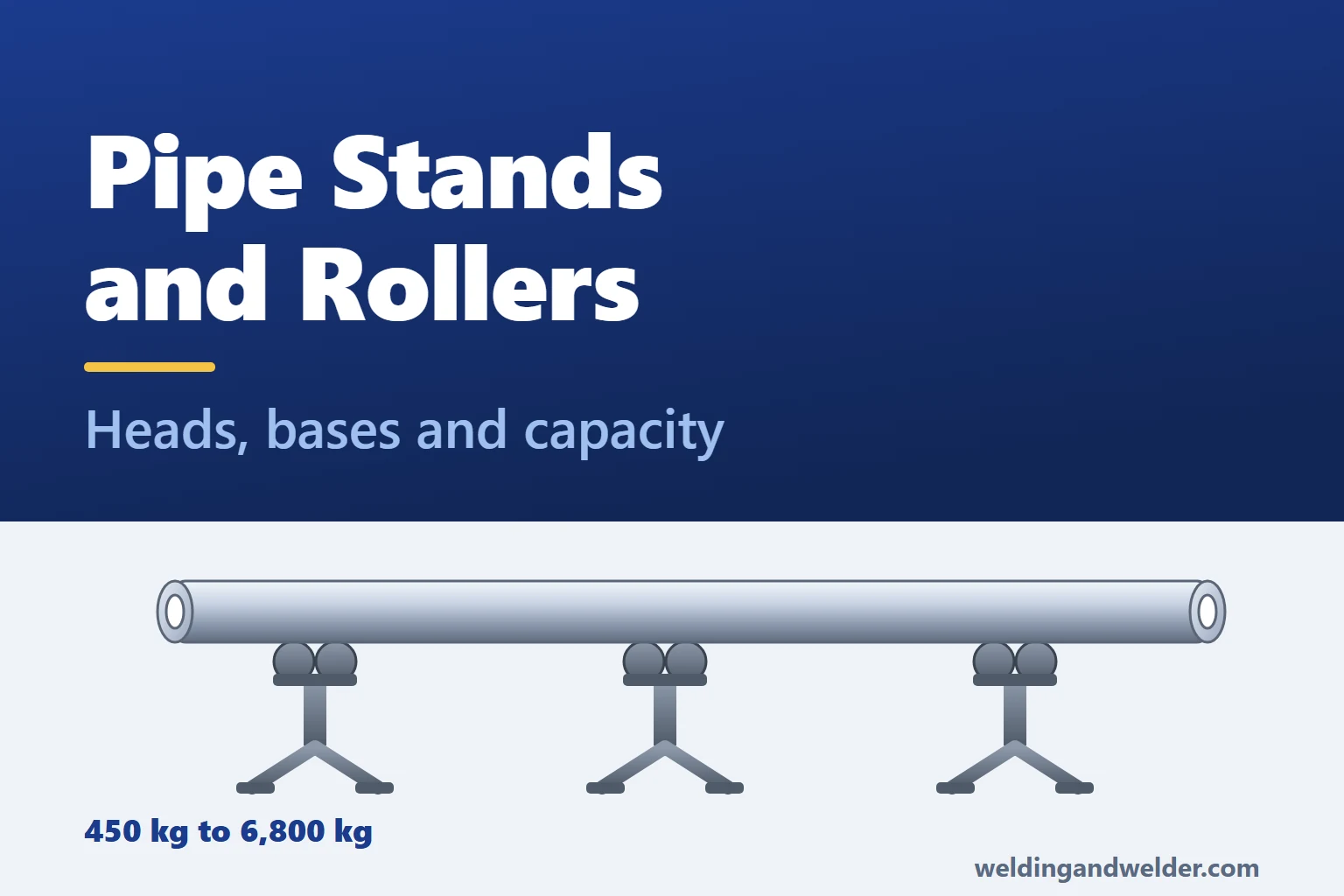
A pipe stand supports the work at the height you need for cutting, fitting up or welding. Choosing one takes a little more thought than the name suggests, because bases, heads, wheel kits and hold-downs may be sold separately. Understanding what each part does makes it easier to order a complete setup that suits the job.
This guide works through the main choices, from the load and pipe diameter to the movement you need, before looking at how to match the head and base.
In this guide:
What Actually Decides the Choice
Work through these four questions in order. Each one helps narrow the choice before you compare individual stands and accessories.
- What load will each stand carry? Work out the share carried by an individual stand, including any uneven loading, rather than using the weight of the whole run or assuming an equal split. The capacities listed here range from 450 kg to 6,803 kg.
- What pipe diameter do you need to support? Standard V-heads are often listed for 0 to 12 inches and larger versions for 0 to 24 inches, while some larger stand assemblies cover 48 or 60 inches. Check the pipe-size range of the complete setup.
- Does the pipe need to turn? Roller heads allow it to rotate for a rolled weld, while a V-head provides fixed contact surfaces for work that stays in position. Decide this early, as it has a major influence on the head you choose.
- What surface will the stand sit on? Some four-leg and five-leg designs have levelling pads, but every stand needs firm, stable support and must be set up within its manufacturer’s limits. Extra legs do not make soft ground suitable for a heavy load.
The Base and the Head Are Two Separate Decisions
Many pipe stands have a separate base and head, with the head fitted to the support post. Depending on the product, you may be buying the complete assembly or just one part of it. Look out for descriptions such as “stand only”, heads supplied singly or in pairs, and wheel kits listed separately.
With compatible parts, this arrangement lets you use the same bases for several jobs. Choose the base for the load and working conditions, then select an approved head for the movement the task requires. Quick-change heads make switching between those jobs easier, provided each combination suits the stand.
Before ordering, confirm whether the listing includes a complete stand, a base or a head. Similar product photographs can hide very different contents, so check what is supplied as well as the price.
Head Types and What Each One Does
The head determines how the pipe can be positioned or moved while supported. Use the table to compare the main types, bearing in mind that support alone does not secure the work against unwanted movement.
| Head | Pipe can | Use it for |
|---|---|---|
| V-head | Rest in a fixed vee; additional restraint may be needed | Fixed-position welding, fit-up, cutting and tacking |
| Roller or wheel head | Turn about its axis | Rotating the pipe to keep the weld in the flat position |
| Ball transfer head | Move in several directions | Positioning fittings and lining up joints |
| Feed-through rollers | Move lengthways | Feeding pipe into a saw or beveller and moving long lengths |
V-Head
A V-head is a common starting point for work that stays in a fixed position. Its angled sides centre the pipe within the head’s rated size range, so the same head can accommodate several diameters. Standard examples are listed for 0 to 12 inches and larger versions for 0 to 24 inches, with capacities typically around 1,000 kg; check the exact model before choosing.
The fixed contact surfaces suit fit-up, cutting and welding where the pipe does not need to turn freely. A V-head is not a clamp, though, so provide restraint where the job requires it. You can compare the available V-head pipe stands and heads with your pipe size and load.
Roller and Wheel Heads
A roller head supports the pipe on wheels arranged in a vee, allowing it to turn about its axis. The examples here range from 450 kg with nylon wheels to 2,200 kg with steel or stainless wheels, with many covering roughly 1 to 24 inches. Match both the wheel type and its rating to the work.
Double roll stands use two rolls on each arm to spread the load and support larger diameters. Examples extend to 48 inches and 2,400 kg, depending on the model. Browse the roller pipe stands and double roll stands to compare the configurations.
Ball Transfer Heads
A ball transfer head uses balls held in housings to allow movement in several directions. This can make fit-up easier when you need to slide a flange into position or turn an elbow to align a joint. Keep the work supported and controlled throughout the movement, as the head reduces resistance without securing the load.
Options include standard-duty and heavy-duty versions in steel or stainless, along with pairs of quick-change heads for compatible double roll stands.
Feed-Through Rollers
Feed-through rollers are arranged to let the pipe move lengthways. They suit cutting and bevelling stations where material needs to feed into a machine, as well as longer runs that must travel along their supports. These are usually supplied as kits for particular floor-mounted or roller stands, so check the base compatibility before ordering.
Steel, Stainless, Nylon or Polyurethane
The material touching the pipe affects both durability and surface condition. This becomes particularly important with stainless steel, where contact with contaminated tooling can leave iron on the surface.
| Material | Typical capacity | Notes |
|---|---|---|
| Steel | 1,000 to 2,200 kg | A durable option for carbon steel. Check the individual head’s rating and price. |
| Stainless steel | 1,000 to 2,200 kg | Suitable for stainless pipe when kept clean and free from carbon steel contamination. |
| Nylon | 450 kg | Helps protect the pipe surface from marking. Check capacity and keep the contact surface clean. |
| Polyurethane | Around 750 kg | Often chosen for quieter running and protection of finished surfaces; check the product’s rating. |
Iron transferred from carbon steel tooling can later appear as rust staining on stainless and may contribute to localised corrosion. That is why workshops keep separate grinding and brushing tools for stainless work. For occasional jobs, a compatible stainless cover kit may let you adapt an existing V-head; keep the cover clean and free from carbon steel contamination.
Base Types by Capacity
| Base | Capacity | Max pipe | Suits |
|---|---|---|---|
| Single tube | 450 kg | 12 in | Low-level and small-bore work, including suitable bench or bolted installations |
| Three leg, fixed or folding | 450 to 1,500 kg | 12 in | General workshop support, with folding versions for transport to site |
| Four leg | 2,500 kg | 36 in | Heavier pipe on a firm, level floor |
| Five leg | 2,265 kg | 36 in | Work needing levelling adjustment and compatible hold-down options; requires stable footing |
| Multi-stand | 2,000 kg | 48 in | Larger diameters, with a choice of compatible wheel kits |
| Double roll | 1,361 to 2,400 kg | 48 in | Rolled welding, with two rolls on each arm |
| Mega roller | 2,721 to 6,803 kg | 60 in | Heavy pipe spools and vessel work |
| Floor mounted | Up to 2,200 kg | Varies by kit | Permanent cutting and feeding stations |
| AMA roller stands | 560 to 1,500 kg | 720 mm | Matched support sets and compatible purge-gas turntables |
Use these capacity and size figures as examples from the range, then confirm the rating of the complete configuration you intend to use. Each stand must cope with its greatest expected share of the load, which may be uneven and can change as an assembly turns. Dividing the total weight equally between the stands will not necessarily give a safe working load for each one.
Height Range and Why It Matters
Many stands use a screw for fine height adjustment, but their available working ranges vary considerably. The examples below show why it is worth checking the minimum height as well as the maximum:
- Single tube stands: roughly 175 to 700 mm
- Three leg stands: commonly 70 to 122 cm, with taller versions reaching 180 cm
- Four leg and double roll stands: around 74 to 109 cm
- Mega roller stands: around 86 to 122 cm
Choose stands whose adjustment ranges overlap at the height you need. For matching head arrangements, two stands that reach 122 cm can work with one that stops at 109 cm, provided all can be set to 109 cm or a suitable lower height. The shorter stand only becomes a problem when you need to work higher. If the head designs differ, check the resulting pipe centreline as well as the quoted stand height.
Set the working height around the task and the operator’s access to it. A rolled weld may call for a different position from cutting or fit-up, so check where the joint or cutting point will sit once the pipe is on the heads.
Castors and Roller Heads Are Not the Same Wheels
The term “wheel kit” can describe either wheels that move the stand or rollers that support the pipe. Establish which type you need before comparing the listings.
- Castor kits fit to the legs so the stand can be moved. Listed options include 450 kg, 1,000 kg and 2,000 kg versions with steel, stainless or nylon-coated wheels. Check the rating for the approved assembly, and do not assume castors permit moving it while loaded.
- Roller and wheel head kits fit at the top to support the pipe while it turns. The examples range from 450 kg nylon versions to 2,200 kg stainless versions, with the permitted load depending on the specific kit and stand.
Check where the kit fits, which stand models it is approved for and what load rating applies to the finished assembly. Most kits are designed for a particular base, so a similar appearance does not establish compatibility.
Rotators and Conveyors
As the work becomes larger or more repetitive, it may be worth moving from individual supports to equipment that also controls how the pipe travels or turns.
Pipe rotators turn the pipe at a controlled welding speed, so the welder can work from one spot with the weld in the flat position. The range examples are 1 tonne for diameters of 115 to 500 mm, 3 tonne for 100 to 1,200 mm, and 5 tonne for 240 to 2,500 mm. The listed 5 tonne unit requires a 415 V three-phase supply, so confirm the chosen model’s electrical requirements before delivery.
Pipe conveyors support material as it moves through the workshop. The examples include 2, 4 or 6 roll configurations, with ratings of 1,134 kg for 2 to 24 inch pipe and 4,536 kg for larger sizes up to 60 inches. Check which size and load limits apply to the configuration you are considering.
Allow for floor space and material flow when considering either option, since the equipment needs to fit the way work moves through the shop. To assess the value of a rotator, look at how much of the shift is currently spent repositioning the work and how much is spent welding.
Setting Up
- Support the work on both sides of a weld or cut. Plan the stand positions so each section remains stable, including after a cut separates it. An unsupported length can load the joint or fall when the cut is completed.
- Establish a stable, level base before setting the height. Use levelling pads where fitted, following the stand’s instructions, and make sure the feet are securely supported. Check that the height adjustment is locked before loading.
- Control unwanted rolling or sliding. Use compatible chain locks or hold-downs where needed, choosing an arrangement that suits whether the pipe must remain fixed or turn in a controlled way.
- Assess the balance of elbows, flanges and other uneven assemblies. These can shift the centre of gravity as the work turns. Where counterweights are needed, use a designed and approved arrangement, accounting for the extra load rather than adding weight by guesswork.
- Keep within the complete assembly’s rating and every component limit. A 2,500 kg base with a 450 kg nylon head cannot be treated as carrying more than 450 kg, and the approved configuration may have a lower limit.
Stands carry the weight and help you position the pipe, while suitable clamps control the joint fit-up. Our pipe welding clamps guide explains how to set the root gap and control hi-lo, the mismatch between the pipe edges. If the joint is stainless and needs a back purge, the weld purging guide covers that part of the setup.
Frequently Asked Questions
What is a pipe stand used for?
A pipe stand supports the work at a suitable height for cutting, fitting up or welding. The head determines whether the pipe rests on fixed surfaces, turns on rollers or moves lengthways into a saw or beveller. Choose the stand and any restraints together so the load remains stable throughout the job.
What is the difference between a V-head and a roller head?
A V-head supports the pipe on fixed surfaces and commonly suits fit-up, cutting and fixed-position welding. A roller head allows rotation, making it useful for keeping a rolled weld in the flat position. Some bases accept both types, but check that the head is approved for your model and that the complete assembly has sufficient capacity.
How many pipe stands do I need?
Plan the number and spacing around the pipe’s weight, length, diameter and wall thickness, along with the work being done. Both sides of a joint need suitable support, and each piece must remain stable after a cut. Follow the equipment instructions and assess the load at each stand; visible sagging is a warning, not a reliable way to determine the required support.
Do I need stainless heads for stainless pipe?
Use suitable, clean contact surfaces to avoid transferring carbon steel contamination onto stainless pipe. Stainless heads, suitable nylon components or compatible stainless V-head covers can help, provided they are kept free from contamination. This reduces the risk of later rust staining and localised corrosion without necessarily requiring a second complete stand.
Can I fit a different head to a pipe stand I already own?
You can do this where the manufacturer offers a compatible head for your stand. Some systems have quick-change V-heads, rollers or ball transfers, allowing one base to serve different tasks. Check the approved fit and the capacity of the new combination before buying, as interchangeable heads are not universal.
What is the difference between a pipe stand and a pipe rotator?
A pipe stand supports the load without driving it; roller heads allow the pipe to turn. A rotator adds a powered drive to turn it at a controlled speed while the welder stays in position. Compare load and diameter limits as well as electrical requirements, since larger rotators may require a three-phase supply.
Explore the full range of pipe welding stands, jacks and rollers, or the wider pipe welding tools and equipment range. If you need to match heads and wheel kits to existing stands, or choose a rotator for a particular vessel, send the details through the technical enquiry form so we can help you identify a suitable setup.