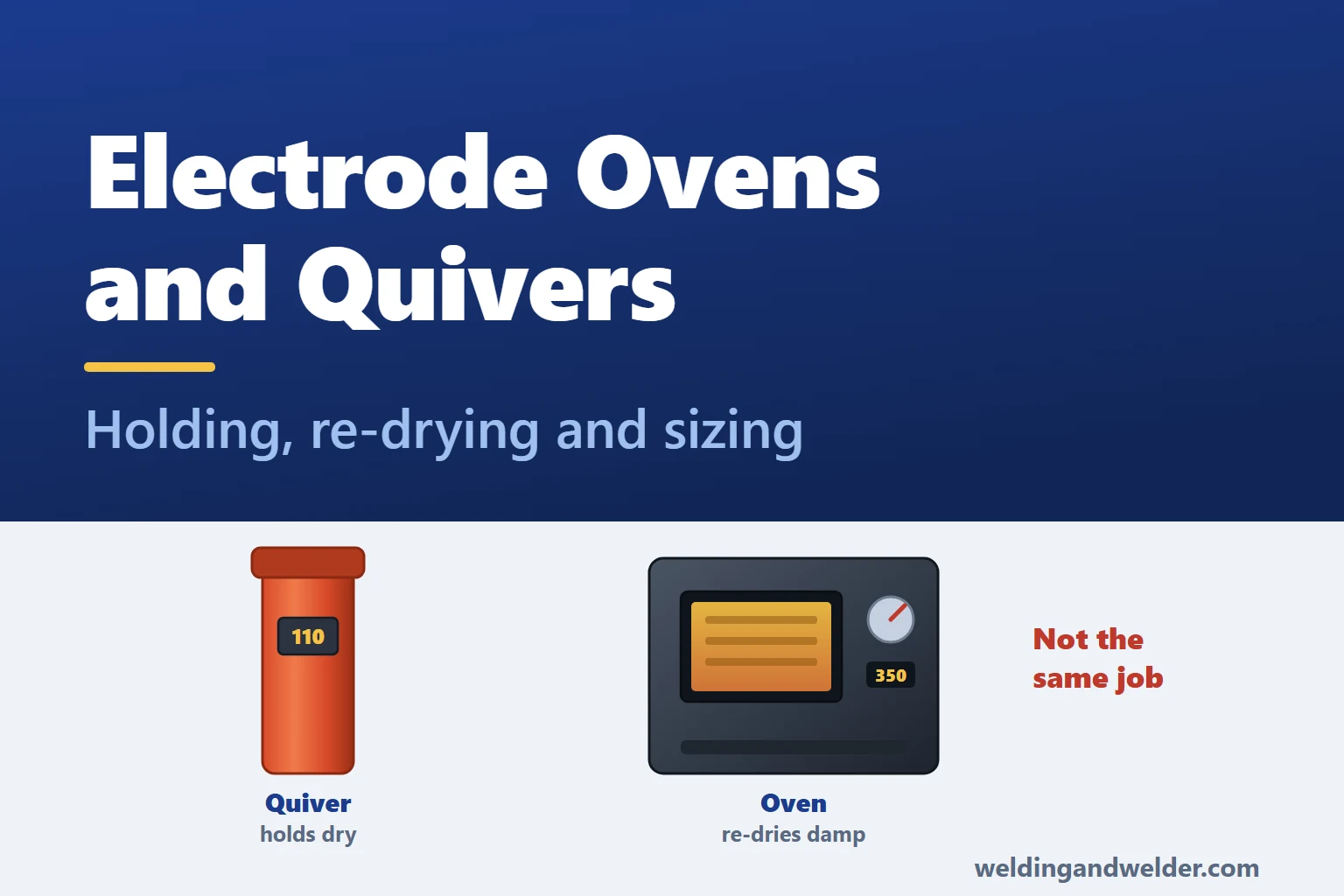
If you use low-hydrogen electrodes, keeping the coating dry is part of getting a reliable weld. Moisture absorbed from the air can increase the hydrogen that reaches the weld, so careful storage helps preserve the electrode’s performance. Ovens and quivers help in different ways: holding keeps dry electrodes ready for use, while re-drying removes absorbed moisture using a heating cycle approved for that product.
In this guide:
Quiver, Portable Oven or Static Oven
| What it is | Typical range | What it can do | |
|---|---|---|---|
| Quiver | A portable insulated container, often electrically heated, for the welder’s working supply | Around 80 to 130 degrees C | Maintains suitable dry electrodes at the point of use when its temperature meets the procedure. Does not replace high-temperature re-drying. |
| Portable oven, lower temperature | A compact oven for a work bay or small workshop, typically 5 to 10 kg | Around 50 to 150 or 200 degrees C | Usually used for holding low-hydrogen electrodes. Its rating may be too low for their required re-drying cycle. |
| Portable oven, higher temperature | A portable unit with a higher maximum temperature | Around 50 to 350 degrees C | Can re-dry only products whose approved cycle falls within its capability; some low-hydrogen products require more than 350 degrees C. |
| Static oven | A larger fixed oven for bulk handling, often 200 kg or more | Up to around 500 degrees C | Can provide bulk holding or approved re-drying cycles, depending on the model. A high maximum temperature does not make every electrode recoverable. |
A practical setup may combine a central oven with quivers that keep a controlled supply close to each welder. Whether you also need re-drying capability depends on the electrodes, their packaging and how they are issued and returned. You can compare the options in our electrode oven and quiver range.
Holding Is Not Re-Drying
Start by deciding whether you need to preserve dry electrodes or recondition exposed ones. That determines the temperature capability you need, rather than the size or portability of the unit alone.
For example, E7018 left open in a damp workshop over a weekend should not be assumed ready to use simply because it has been put in a quiver at 100 degrees C. Check its exposure history and the manufacturer’s instructions to establish whether re-drying is permitted and what cycle it needs. Where it can be re-dried, the electrodes should then move into the specified holding conditions; severely damaged or contaminated electrodes may need to be discarded.
Electrode Storage and Drying
| Electrode | Oven or quiver? |
|---|---|
| Low hydrogen, E7016 and E7018 | Usually need controlled storage after opening, unless the packaging and procedure permit direct use within a stated exposure period. Moisture pickup can compromise low-hydrogen performance. |
| Cellulosic, E6010 and E6011 | Do not apply a low-hydrogen baking cycle. Their coating needs a controlled moisture content. Keep them in the specified storage conditions and follow the maker’s instructions; many products must not be re-dried. |
| Rutile, E6013 | Normally kept in dry, protected storage. Some products can be re-dried if the manufacturer permits it; use their own cycle rather than a low-hydrogen schedule. |
| Basic coated stainless and low alloy | Often require controlled storage or re-drying, with temperatures specific to the product and coating. |
If you need help identifying the product, our electrode selection guide explains how to read the AWS classification. The storage requirements of low hydrogen electrodes are a common reason for using ovens and heated quivers, although other electrode types can also need controlled drying or storage.
Temperatures by Electrode Type
| Electrode | Holding | Re-baking |
|---|---|---|
| Low hydrogen, E7016 and E7018 | Common holding guidance is around 120 to 150 degrees C, but confirm the product and procedure requirements | Use the product’s specified temperature, time and any preliminary drying stage; the classification alone does not define a cycle |
| Cellulosic, E6010 and E6011 | Keep in the manufacturer’s specified dry, protected storage conditions | Usually not permitted; never apply a low-hydrogen cycle without explicit product instructions |
| Rutile, E6013 | Usually dry, protected storage at room temperature | Only where the manufacturer permits it, using the product-specific temperature and time |
| Vacuum packed low hydrogen | May be used directly from an intact pack within the permitted exposure period; holding requirements depend on the procedure | May be required after excessive exposure or loss of package integrity, if the product and its condition permit recovery |
Use these figures to understand the difference between holding and re-drying, rather than as settings for every product in a classification. The electrode instructions and the welding procedure must agree on the temperature, time and handling sequence; resolve any difference before processing the electrodes.
Choosing: Temperature, Capacity and Voltage
- Decide whether re-drying is part of your process. Intact vacuum-packed electrodes may be usable directly within their stated exposure limits, so a re-drying oven may not be needed. If electrodes can exceed those limits, arrange an approved re-drying or disposal route before issuing them.
- Match the oven to the required cycle. A unit limited to 150 degrees C cannot perform a low-hydrogen re-drying cycle that requires a higher temperature, however long the electrodes remain inside. Check any preliminary drying stage as well as the final temperature.
- Choose capacity around the way you issue electrodes. A quiver carries a manageable working supply, while a 5 or 10 kg portable oven may serve a bay or small workshop. A 200 kg static unit suits bulk handling, provided the loading arrangement allows the electrodes to heat evenly.
- Check the available power supply. Many workshop units use 230 V, while construction sites commonly specify 110 V. A suitable dual-voltage model can be useful when equipment moves between locations; confirm its connection and changeover requirements.
- Check temperature control and the condition of the lid. The unit needs to maintain the required temperature under load. Look for suitable controls, a way to verify temperature and a properly fitting closure, while keeping any designed vents clear.
Compare GYS, SWP and Weldability Sif models against the temperatures your electrodes require. The ranges illustrated here extend from quivers around 80 degrees C through portable units rated to 150, 200 or 350 degrees C and static ovens reaching 500 degrees C. Check the individual model’s operating range and suitability for the full cycle.
Site Work and Dual Voltage
On site, the challenge is keeping the same control when the welder is some distance from the store and working in changing weather. Plan how electrodes will reach the work area, stay protected during use and return to controlled storage if they are not used.
- Confirm the site’s electrical requirements before buying. A 110 V centre-tapped-to-earth supply is commonly used on UK construction sites. If the unit will also be used in a workshop, check whether a suitable dual-voltage model meets both arrangements.
- Keep a controlled supply close to the welder. A suitable heated quiver reduces trips to the central oven and helps prevent electrodes being left on a bench or carried loose in a pocket.
- Protect electrodes from damp conditions and condensation. Outdoor work needs particular care because rain, damp air and condensation can affect electrode condition. Follow the product’s exposure limits and instructions for bringing cold packs to room temperature before opening.
- Plan what happens to overexposed electrodes. Keep them separate from usable stock and send them for authorised re-drying where permitted. If their condition or history makes that unsuitable, discard them rather than returning them to use.
Using Them Properly
- Follow the specified loading and heating sequence. Some cycles need preliminary drying or controlled heating, so do not assume every electrode should go straight into a hot oven. Start the specified drying time when the electrode load has reached the required temperature.
- Leave enough space for even heating. Follow the oven’s loading limits and the electrode maker’s layer-depth guidance so the centre of the load reaches the required temperature as well as the outside.
- Move re-dried electrodes into the specified holding conditions. Keep the transfer controlled and avoid leaving them exposed to workshop air while they cool.
- Track permitted re-drying cycles. Follow the product’s limit and reject electrodes with damaged or flaking coatings, contamination or other deterioration. Further heating cannot repair every form of damage.
- Use dedicated electrode-drying equipment. A domestic cooking oven is not an appropriate substitute for equipment selected to control and verify the required cycle, and it should not be used to process welding consumables.
- Load the quiver with an identifiable working quantity. Issue enough for the planned work and exposure allowance, and keep returns separate where needed so fresh stock is not mixed with electrodes whose history is uncertain.
Exposure Time, Records and Procedures
Once a pack is opened, apply the exposure limits specified for the electrode and the job. Record when electrodes are issued and returned so you can track time outside the required storage conditions. Putting them back into a warm quiver does not, by itself, reset that history or establish that they are fit to use.
- Record when the pack is opened. A date and time on the packaging is a useful starting point; retain the product and batch details and any further issue records required by the job.
- Verify holding temperatures and keep the required records. Check ovens and quivers as the procedure specifies, rather than relying solely on the control dial or indicator light.
- Read the hydrogen and moisture-resistance designations separately. H4, H8 and H16 identify diffusible-hydrogen limits in millilitres per 100 grams of deposited weld metal under the classification test conditions. R indicates tested resistance to moisture pickup. H4R does not give an unlimited exposure time or remove the need for correct handling.
- Allow for delayed hydrogen cracking. Cracks can develop after welding as hydrogen acts in a susceptible, stressed joint, sometimes hours or days later. Electrode control is one part of prevention, alongside the other requirements of the welding procedure.
Our guide to common MMA welding problems explains hydrogen cracking and the other problems that can arise when electrode condition or welding controls are unsuitable.
Frequently Asked Questions
What is the difference between an electrode oven and a quiver?
A quiver keeps a manageable supply of electrodes close to the welder, often at around 80 to 130 degrees C. An oven usually offers more capacity, and some models reach the higher temperatures needed for re-drying. The name alone does not establish what a unit can do: compare its controlled operating range with the holding or re-drying cycle required by the electrode.
What temperature should a welding electrode oven be set at?
Use the settings specified for the actual electrode and the job. Holding guidance for many low-hydrogen products is around 120 to 150 degrees C, while re-drying requires a separate, product-specific cycle, often at a much higher temperature. Check the duration, any preliminary drying stage and the transfer into holding as well as the final setting.
Can a quiver dry damp electrodes?
A holding quiver should not be used as a substitute for a low-hydrogen re-drying cycle. It is intended to maintain suitable electrodes near the welder, often at around 80 to 130 degrees C. If electrodes have exceeded their permitted exposure or absorbed moisture, check whether the manufacturer allows re-drying and use equipment capable of the required cycle.
Which electrodes need to be kept in an oven?
Low-hydrogen electrodes such as E7016 and E7018 commonly need controlled storage after opening, although suitable sealed packaging can allow direct use within a stated exposure period. Cellulosic E6010 and E6011 need different handling and must not be subjected to a low-hydrogen baking cycle. Rutile E6013 normally needs dry storage, with re-drying only where its manufacturer permits it.
Can I use a domestic oven to dry welding rods?
Use dedicated equipment suitable for the electrode’s drying cycle. A household cooking oven is not an appropriate substitute for the required temperature control, load arrangement and verification, and should not be used for welding consumables. Check that the electrode oven can perform the complete cycle, rather than choosing it on maximum temperature alone.
Do I need 110V or 230V?
Match the oven or quiver to the supply and rules at the place of use. Workshop models commonly use 230 V, while many UK construction sites specify a 110 V centre-tapped-to-earth system. A suitable dual-voltage unit can cover both, but its connection, changeover method and power requirements still need checking.
How many times can electrodes be re-baked?
Use the limit set by the electrode manufacturer and any tighter job requirements. Repeated or excessive heating can damage the coating or affect performance, and badly damaged electrodes may need rejection before that limit is reached. Keep a record of the cycles and review storage and issuing arrangements if re-drying is repeatedly needed.
Browse electrode ovens and quivers, or use the technical enquiry form to tell us the electrode you use, how much you get through and whether the supply needs to be 110 V. Those details help us identify the temperature range and capacity that suit the work.