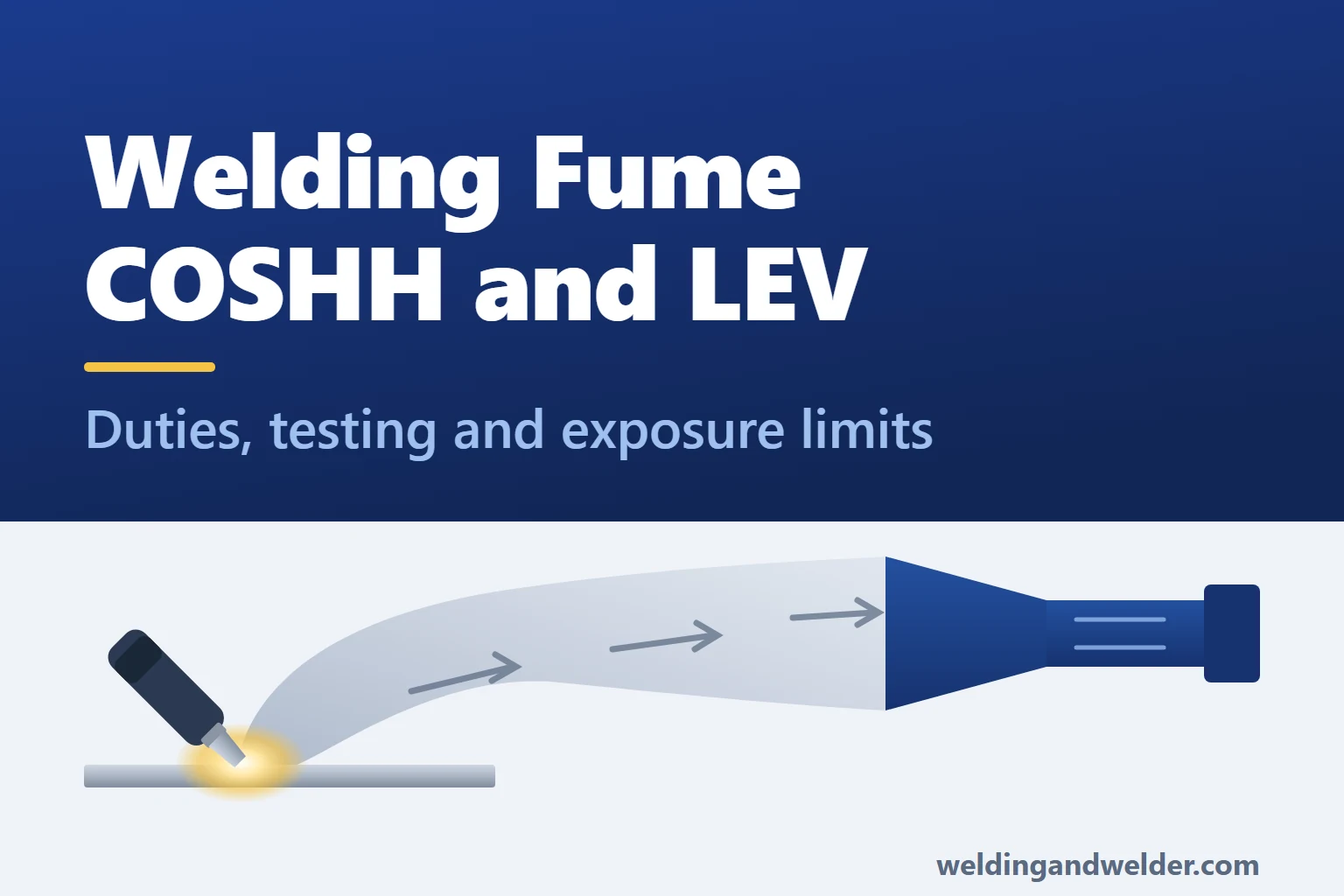
All welding fume, including mild steel fume, can cause cancer. Following its classification as carcinogenic to humans by the International Agency for Research on Cancer in 2017, HSE issued a safety alert in February 2019. Employers must prevent exposure where reasonably practicable and otherwise control it adequately, with measures chosen to suit the process, location and amount of work.
In practice, exposure to welding fume must be reduced to as low as is reasonably practicable, often shortened to ALARP, while also meeting any limits for individual substances. Meeting a limit is part of that responsibility; it does not remove the duty to reduce exposure further where reasonably practicable.
This guide takes you through the controls, checks and records employers need to have in place. If you are also choosing equipment or deciding where to position it, our welding fume extractor buying and setup guide covers those practical decisions.
In this guide:
Welding Fume Hazards and Exposure Limits
No Single Exposure Limit Covers Welding Fume
EH40 does not set a workplace exposure limit for welding fume as a whole. Where a workplace exposure limit, or WEL, applies to a substance, it sets a limit averaged over a stated period. General dust figures must not be used as safe limits for welding fume.
Because welding fume can cause cancer and no safe level of exposure has been established, exposure must be reduced to as low as is reasonably practicable.
Limits for Individual Substances
Some individual substances in welding fume, and gases produced during welding, have their own WELs, which must be met alongside the duty to reduce exposure. When looking up a limit in the current EH40 edition, make sure you are using the entry for the correct substance, particle fraction and averaging period.
| Substance | Where it comes from | Health risk and exposure limits |
|---|---|---|
| Hexavalent chromium, Cr(VI) | Stainless steel, some high-alloy steels and chromium-containing coatings | Can cause cancer and occupational asthma. EH40 sets a limit |
| Nickel compounds | Stainless steel and nickel alloys such as Inconel and Monel | Some can cause cancer and asthma. EH40 distinguishes water-soluble from insoluble compounds |
| Manganese | Many steel filler metals and some fluxes | Long-term exposure can damage the nervous system. EH40 has limits for inhalable particles (breathed in) and respirable particles (small enough to reach deep into the lungs) |
| Zinc oxide | Galvanised and zinc-coated steel | Can cause metal fume fever, with flu-like symptoms. Welding galvanised steel still requires effective fume control |
| Ozone | Forms when ultraviolet light from the arc reacts with air; a particular concern in some TIG and aluminium work | Irritates and can damage the lungs. EH40 sets a short-term exposure limit |
| Nitrogen oxides | Arc and oxy-fuel processes | Can irritate and damage the lungs, sometimes with delayed symptoms after high exposure. Check the limit for each gas |
| Carbon monoxide | Can form from carbon dioxide shielding gas or incomplete combustion; may build up in enclosed spaces | Poisonous gas that reduces the blood’s ability to carry oxygen. EH40 sets exposure limits |
| Fume and gases from coatings | Paint, primers, zinc coatings, plating and lead-containing paint | The hazards depend on the coating, so identify it before welding. Lead also has separate workplace control requirements |
Check exposure figures in the official publication. Use the latest HSE publication EH40/2005 Workplace exposure limits alongside the safety information for your consumables, base metal and coatings. Pay attention to the averaging period as well as the figure itself, because an eight-hour average and a short-term limit describe different periods of exposure.
Your Legal Duties Under COSHH
The requirements in this guide are those that apply in Great Britain under the Control of Substances Hazardous to Health Regulations 2002, known as COSHH, together with HSE guidance. Northern Ireland has its own COSHH regulations and regulator, HSENI.
| Duty | What it means for welding |
|---|---|
| Assess the risk | Start with the processes, materials, consumables and coatings, then identify who could breathe the fume and how much exposure is likely. Review the assessment regularly and after significant changes |
| Prevent or control exposure | Consider whether welding can be avoided or fume reduced, then combine engineering controls, safe working methods and respiratory protective equipment (RPE) as needed |
| Maintain the controls | Keep extraction in working order and arrange a thorough examination and test at intervals no longer than 14 months, or sooner where needed |
| Monitor exposure | Arrange suitable exposure measurements where the assessment shows they are needed to check the risks or how effectively the controls are working |
| Health surveillance | Arrange appropriate health checks where the COSHH assessment identifies a relevant disease risk and a suitable way to detect early harm |
| Inform, instruct and train | Explain the hazards, correct use of extraction and RPE, routine checks and how to report faults |
Equipment must work and be used correctly. An extractor cannot control exposure if it is switched off or badly positioned, so buying the equipment is only part of putting effective controls in place. Those controls must protect other people nearby too, including fitters, labourers and inspectors.
Choosing Controls in the Right Order
The hierarchy of control helps you work through the options in order, starting with preventing exposure. Consider each step and record why the measures you choose are suitable for the work. In practice, this may mean combining extraction, safe working methods and RPE to provide the protection needed.
- Avoid welding where possible. Where the joint design allows bolts, rivets or adhesives, using them avoids producing welding fume for that joint.
- Reduce the fume produced. Look for a suitable process or consumable that produces less fume, and remove coatings before welding where practicable. The removal work also needs controls for any dust or vapour it creates.
- Use engineering controls. Local exhaust ventilation, or LEV, captures fume close to where it is produced and is normally needed for regular indoor arc welding. Enclosures and automation can also reduce exposure, although automated welding still produces fume that must be controlled.
- Use safe working methods. Keeping your head out of the rising fume, positioning extraction correctly and training workers to use it are all part of effective control. Provide suitable general ventilation as well, and remember that welding screens protect against arc light but do not remove fume.
- Use respiratory protection where needed. Suitable RPE must be provided where extraction cannot adequately control exposure or is not reasonably practicable, and HSE also requires it for outdoor welding. Because it protects only the wearer, you still need to consider everyone else nearby.
Ventilation and Airflow
When General Ventilation Is Enough
General ventilation replaces room air and dilutes pollutants, helping to clear background fume. It usually cannot protect someone breathing the concentrated plume from regular arc welding, although HSE recognises some exceptions. Good general ventilation is usually enough for low-intensity resistance spot welding on clean, uncoated metal. For occasional welding less than once a week and lasting under an hour, HSE normally accepts suitable RPE with good general ventilation, provided people nearby are also protected.
An air-change rate tells you how often the room air is replaced, but it cannot, on its own, show how much fume the welder breathes or demonstrate that exposure is adequately controlled.
Checking Airflow and Fume Capture
Check that the extraction captures the fume during the actual work. For conventional capture hoods, HSE gives a guide range of 0.5 to 1 metre per second at the source, although higher velocities may sometimes be needed where draughts interfere. Use this as guidance rather than a universal pass mark. On-torch systems need a different approach, with checks based on the manufacturer’s specified airflow.
| Extraction type | How to specify the airflow | What to check |
|---|---|---|
| On-torch extraction | Use the torch manufacturer’s required flow and suction pressure | The extractor needs to match the torch, hose and connections, with capture checked in the welding positions used |
| Extraction arm with 160 mm duct | Use the hood and system design figures | Use the effective capture distance as part of the check, because duct diameter alone does not determine the airflow required |
| Extraction arm with 200 mm duct | Use the hood and system design figures | Check hood shape, hose losses and the number of arms used at once |
| Downdraught bench | Specify flow for the working area and required downward air speed | Check capture with representative parts in place, as the workpiece can obstruct airflow |
| Booth or enclosure | Specify flow for the openings and process | Check containment while the operator loads, welds and unloads the work |
Keep the hood within its effective capture range. Suction falls quickly as the distance increases, while hood shape, airflow and draughts also affect how well it works. This is why fitting a larger fan will not solve every positioning problem. Our extraction buying and setup guide explains how to position the hood.
Replacement Air and Draughts
- Replace the air you extract. When air is discharged outdoors, a planned supply of replacement air, also called make-up air, needs to take its place. Without enough replacement air, extraction performance can fall and strong draughts can develop through doors and gaps.
- Keep supply air from disrupting capture. Position the inlets so the incoming air does not blow fume away from the hood or across the welder’s face.
- Check for cross-draughts. Open doors, cooling fans and heaters can all push fume away from the extractor, so assess capture under the conditions normally found in your workshop.
- Discharge extracted air safely. Position the outlet away from doors, windows and air intakes to prevent pollutants re-entering your building or entering another one.
Choosing Filters for the Hazards
| Process or material | Hazards to assess | What the system needs to do |
|---|---|---|
| Mild and carbon steel | Fine metal particles, including iron and manganese compounds | Capture the fume using filtration that suits its particles and concentration, with gases assessed separately |
| Stainless, duplex and nickel alloys | Metal particles that may contain chromium(VI) and nickel compounds | Use suitable high-efficiency particle filtration. W3 certification provides useful evidence of tested performance, although it cannot, on its own, establish that recirculation is safe or COSHH-compliant |
| Galvanised and zinc-coated steel | Zinc oxide | Combine effective fume capture with suitable particle filtration, as a filter label alone does not show that the welder is protected |
| Aluminium welding and TIG processes | Ozone and other gases, as well as particles | Assess gases separately because particle filters do not remove ozone. Use gas treatment only where its performance and replacement schedule suit the gas you have identified |
| Flux-cored welding | Often a high load of fume particles; gases also need assessment | Size the extractor and filter around the workload, considering automatic filter cleaning where the equipment supports it |
| Plasma and oxy-fuel cutting | Metal particles and gases, which depend on the cutting process | Use suitable extraction with a table or enclosure. Neither particle filtration nor a generic carbon stage can be assumed to control every gas |
| Aluminium and magnesium dust | Fire and explosion from combustible metal dust | Use a collection system designed for the dust and its fire and explosion risks. Keep incompatible dusts and ignition sources separate; do not use an ordinary welding-fume unit without specific approval for the task |
| Painted or coated material | Particles and gases released as the coating heats | Identify the coating and review its safety information before deciding how to remove it safely where practicable. Assess the welding hazards that remain |
You can browse replacement filters or use the buying guide to compare filtration systems. Ideally, extracted air should be discharged safely outdoors; if it is returned indoors, you need to show that it is adequately cleaned and monitor for filter failure. A particle filter or W3 label does not demonstrate that welding gases have been removed, and a generic carbon filter is not a solution for every gas.
Respiratory Protection and Face Fit Testing
Respiratory protective equipment (RPE) is needed where other controls cannot adequately protect the worker, including during outdoor welding. The choice needs to account for the particles and gases present, the task and the wearer. Confined spaces require a separate assessment and safe system of work, because filtering respirators do not supply oxygen and cannot protect someone in an oxygen-deficient atmosphere.
- Fit-test tight-fitting masks before use. Each wearer needs a test with the exact make, model and size of mask they will use. They must also check the seal every time they put it on, but that seal check does not replace the fit test.
- Keep the face seal free of hair. Beards or stubble beneath a tight-fitting seal can cause leaks, so select appropriate loose-fitting powered or supplied-air equipment where a suitable seal is not possible.
- Powered and supplied-air helmets work differently. A powered respirator filters the surrounding air, whereas a supplied-air system receives breathing-quality air from a separate source. Loose-fitting models do not need face fit testing, but they still need the correct airflow and must fit correctly around the head and neck.
- Choose enough protection for the hazard. The assigned protection factor (APF) describes the expected reduction in exposure and is one of the things to check, along with the filters and compatibility with other protective equipment. Particle filters do not protect against welding gases.
- Inspect, clean and store RPE correctly. Check the equipment before each use and follow the manufacturer’s instructions for maintenance and filter changes. For reusable equipment, keep records of examinations and repairs too.
- Use RPE as part of the control plan. Providing it does not justify removing effective extraction that is needed to protect the welder and other people nearby.
When comparing respirator masks and air-fed face shields, look at the exact model’s air source, protection level and permitted uses so you can choose equipment that suits the work.
Checking Exposure and Keeping Records
Measuring What Workers Breathe
- A competent occupational hygienist will choose the sampling method and position. For welding particles, samples are usually taken in the breathing zone inside the welding shield, with RPE use taken into account when planning the sampling.
- The tests need to cover the substances and particle sizes relevant to your work, with different sampling equipment potentially needed for gases and metal particles.
- Consider the results alongside observations of the work to decide whether exposure is adequately controlled, bearing in mind that meeting a substance’s limit alone does not satisfy the ALARP duty.
- Ask the hygienist to talk you through the results, what their limitations are and which changes are needed. The way sampling is planned matters, because a poorly planned exercise may miss the highest exposures.
Routine Checks for Fume Capture
- Look for escaping fume. Observe from a safe position with suitable eye protection and investigate any fume that escapes. A lack of visible fume does not, by itself, show that the air is safe.
- Airflow visualisation tests can reveal draughts and poor capture by using suitable smoke or other approved methods. Someone trained to use these methods safely should carry out the tests.
- Check airflow indicators against the system’s normal operating range, while also checking hood position. A normal reading cannot compensate for a hood that is too far from the weld.
- Investigate dust deposits near the work to find out where they are coming from. Poor capture may be the cause, although grinding and other tasks can also leave deposits.
Record Keeping
- Keep LEV examination and test reports for at least five years.
- Keep user checks and maintenance logs with the system records so faults and repairs can be tracked.
- Keep exposure monitoring records for at least 40 years where they represent the personal exposure of identifiable employees; otherwise, at least five years. These periods run from the last entry.
- Keep training and face fit test records for each worker, including the mask make, model and size tested.
- Keep the COSHH assessment up to date by recording reviews and changes. Employers with five or more employees must record its significant findings, and written records are useful for smaller businesses too.
The Required LEV Examination and Test
A thorough examination and test is a legal requirement. It must be carried out by a competent person to establish whether the LEV system still controls exposure effectively. For welding extraction, the gap between tests must not exceed 14 months and may need to be shorter. Changing filters or servicing the fan alone does not meet this requirement.
What the Examination and Test Covers
- Inspect the whole system: check the hood, ducts, filters, fan and discharge point for damage, defects and unsuitable changes.
- Measure the relevant airflow and pressures and compare them with suitable design or commissioning figures. The measurements depend on the system; on-torch extraction is tested differently from a capture hood.
- Check fume control during representative work, including whether fume reaches the operator or nearby workers.
- Provide a written report stating the findings, defects, required action and any restrictions on use.
Keep the Baseline and Act on Defects
- Keep the commissioning report and manual. The checks recorded when the system was first set up provide a baseline for later tests. If that information is missing or unsuitable, a competent examiner will need to establish an appropriate basis for testing.
- Act on defects promptly. Follow the report’s recommendations, stopping work where controls are ineffective and restoring adequate protection before restarting.
Health Surveillance for Welders
Health surveillance is a programme of planned checks for work-related harm. Under COSHH, it is required where exposure could cause an identifiable disease, the working conditions make that disease reasonably likely and there is a valid way to detect it. Your risk assessment determines what is needed for the work you do.
- Respiratory checks may include a questionnaire and lung-function tests. A programme usually begins with baseline checks, then moves on to early reviews and regular checks at intervals advised by an occupational health professional.
- Stainless steel fume can cause occupational asthma. HSE therefore advises respiratory surveillance unless the assessment shows there is no reasonable likelihood of asthma. For nickel alloys and coatings, base the assessment on the substances present.
- Keep each employee’s COSHH health record for at least 40 years from the last entry, separately from the confidential clinical records held by the occupational health professional.
- Health checks do not replace exposure controls. Their results help identify early harm and should be used to review protection and take any recommended action.
A competent occupational health provider can help you decide which workers need surveillance and design a programme that meets those needs.
Maintaining Your Extraction System
Damage, blocked filters and changes to the work can all reduce extraction performance over time. Routine checks help you find these problems before they lead to workers being exposed.
Checks Before Use and Routine Cleaning
- Check that extraction is running and correctly positioned. Follow the system’s operating instructions and reposition movable hoods as the work changes.
- Check fume capture at the start and as the work moves, using suitable eye protection. Investigate fume escaping into the work area.
- Check the airflow indicator against its normal range and record the check. Report low flow or alarms promptly.
- Inspect hoses and hoods for splits, crushing, loose joints and spatter damage.
- Clean bins, spark arrestors and pre-filters at the intervals specified for the system. Follow safe isolation and dust-handling instructions.
Set a Maintenance Schedule for Your System
| Frequency | Task | Why it matters |
|---|---|---|
| At the manufacturer’s interval; more often if loading requires it | Clean intakes and grilles; empty collection bins | Prevents build-up from restricting airflow or creating other hazards |
| As specified; monitor continuously where indicators are fitted | Check filter pressure readings, ducts and seals | Helps identify blockage, leaks or filter damage |
| At planned intervals set for the equipment and its use | Have competent people inspect fans, bearings, drives and electrical components | Finds wear and faults before they cause loss of control |
| No more than 14 months between tests; sooner if needed | Statutory thorough examination and test | Required under COSHH; must be done by a competent person |
| When condition or the specified service life requires it | Clean or replace filters as instructed | Consider pressure readings, damage, leakage and gas-filter service life; pressure alone is not enough |
Common Extraction Problems
| Symptom | Possible causes | What to check or do |
|---|---|---|
| Weak suction at the hood | Blocked filter or duct, full bin, leaks or fan problems | Check the airflow and system condition, then have faults corrected in line with the manufacturer’s instructions |
| Fume escaping capture | Poor hood position, insufficient flow or cross-draughts | Bring the hood within its effective capture range and correct any disruptive draughts, then check capture again |
| Extraction not being used | Awkward positioning, excessive noise, faults or inadequate training | Find out what is preventing use so the problem can be corrected, then train users and supervise use |
| Filter blocking rapidly | High dust loading, unsuitable use, incorrect filters or a cleaning-system fault | Review the intended use, filter specification and cleaning system, keeping grinding separate unless the equipment is designed for both tasks |
| Low airflow reading | Restricted flow, leaks, incorrect damper settings or fan faults | Have a competent person investigate. Do not alter shared-system dampers without checking the effect on other hoods |
| Strong draughts or doors difficult to open | Too little replacement air for the volume extracted | Have the replacement-air supply assessed and balanced with extraction |
Quick Reference: Controls, Checks and Limits
- All welding fume can cause cancer, including mild steel fume. Reduce exposure as low as reasonably practicable.
- There is no single WEL for welding fume. Limits for its individual substances and gases still apply, including ozone.
- Use controls suited to the work. Regular indoor arc welding normally needs extraction. Specific exceptions are explained in the ventilation section.
- Judge extraction by effective capture. Use the appropriate airflow tests and manufacturer’s settings for that type of system.
- Arrange LEV testing within 14 months, or sooner where needed, and keep test reports for at least five years.
- Provide suitable RPE where needed, including outdoors. Fit-test tight-fitting masks; loose-fitting equipment has different fitting requirements.
Quick Reference: Testing and Maintenance
| Task | Frequency | Basis for the interval |
|---|---|---|
| User check of extraction and airflow | Before use and as the work changes | Follow the operating instructions and confirm that controls remain effective |
| Clean pre-filters and empty bins | At the interval specified for the equipment and workload | Manufacturer’s instructions and actual loading |
| Filter pressure drop check | As instructed; check fitted indicators before use | System design and manufacturer’s normal operating range |
| Mechanical and electrical inspection | At planned intervals appropriate to the equipment | Risk assessment and manufacturer’s instructions |
| Thorough examination and test | Within 14 months; sooner where needed | Legal requirement under COSHH |
| Face fit testing of tight-fitting RPE | Before use; repeat after changes to mask type, size or facial characteristics that affect fit | Fit must be demonstrated for the actual wearer and facepiece |
| Health surveillance | Baseline, early and periodic checks as advised for the risk | COSHH assessment and occupational health advice |
Exposure Limits in Great Britain: EH40
| Substance | Status | What to do |
|---|---|---|
| Welding fume | No WEL for the mixture as a whole; it can cause cancer | Reduce exposure as low as reasonably practicable and meet any limits for individual substances |
| Hexavalent chromium | Has a WEL in EH40 | Check the latest applicable limit and its averaging period |
| Nickel compounds | Have WELs in EH40 | Use the correct entry for water-soluble or insoluble compounds |
| Manganese | Has WELs in EH40 | Match the sampling method to the inhalable and respirable limits |
| Ozone | Has a short-term WEL in EH40 | Assess and control this gas separately from particles. Check gas-treatment suitability before recirculating air |
| Nitrogen dioxide, carbon monoxide | Have WELs in EH40 | Check each gas and its averaging period. Assess build-up and oxygen deficiency in enclosed spaces separately |
When checking a limit, use the current version of EH40/2005 Workplace exposure limits for both the applicable value and its averaging period. Read this alongside the safety information for your consumables, base metal and coatings.
Welding Fume Compliance FAQ
Is there a workplace exposure limit for welding fume?
There is no single workplace exposure limit for welding fume as a whole, although EH40 sets limits for some individual substances and welding gases, including chromium(VI), nickel compounds, manganese and ozone. You need to meet the applicable limits while also reducing exposure to welding fume as low as reasonably practicable. General dust figures must not be treated as safe limits for welding fume.
How often does LEV have to be tested?
For welding extraction, COSHH requires a thorough examination and test by a competent person with no more than 14 months between tests. Some systems need testing sooner, and routine checks, maintenance and prompt repairs are still needed between those examinations.
Is general ventilation enough for welding fume?
For regular arc welding, general ventilation is usually insufficient on its own. It can be enough for low-intensity resistance spot welding on clean, uncoated metal, and HSE also allows suitable RPE with good general ventilation for genuinely occasional, short welding tasks. Those exceptions have conditions, explained in the ventilation section, and people nearby must also be protected.
Do I need extraction for welding mild steel?
Regular indoor arc welding on mild steel normally needs effective extraction, with suitable RPE where extraction does not provide enough protection. Mild steel fume can cause cancer, so the metal alone does not determine whether an exception applies. The exceptions for occasional work and low-intensity spot welding depend on the task itself.
What records do I have to keep?
Keep LEV thorough examination and test reports for at least five years. Your records should also include the assessment, maintenance, training and fit-test records. Exposure monitoring records that identify an employee’s personal exposure must be kept for at least 40 years, while other monitoring records need to be kept for at least five years. Required COSHH health records must also be kept for at least 40 years. The 40-year periods run from the last entry.
Does a beard stop you wearing welding RPE?
A beard affects the type of equipment you can use, because facial hair under a tight-fitting mask seal prevents reliable protection. Where the wearer cannot be clean shaven around that seal, choose suitable loose-fitting powered or supplied-air equipment. This does not need a face fit test, but it must fit and be used as instructed, with the hazards, airflow and protection level checked for the exact model.
What is the difference between an LEV service and a thorough examination and test?
Servicing keeps the equipment maintained and repaired, while a thorough examination and test establishes whether the system effectively controls exposure and produces a formal report. Both can be carried out during the same visit, but a service alone does not fulfil the legal requirement for testing.
Do I need health surveillance for welders?
Health surveillance is needed where the COSHH assessment identifies a relevant disease risk and a valid way to detect early harm. Stainless steel welding commonly needs asthma surveillance because the fume contains chromium and nickel. A competent occupational health provider can advise on the baseline, early and ongoing checks needed, alongside the exposure controls that must remain in place.
Use this guide alongside a COSHH assessment for your own work. The materials, process, location and exposure determine which controls you need. Refer to current HSE guidance for Great Britain or HSENI guidance for Northern Ireland, with competent advice where you need help applying it.
👉 Choosing and setting up fume extraction · Fume extraction equipment · Replacement filters · RPE
If you need help choosing equipment for your assessed risks, we can help you specify a suitable system. Tell us what you weld and where to get started.