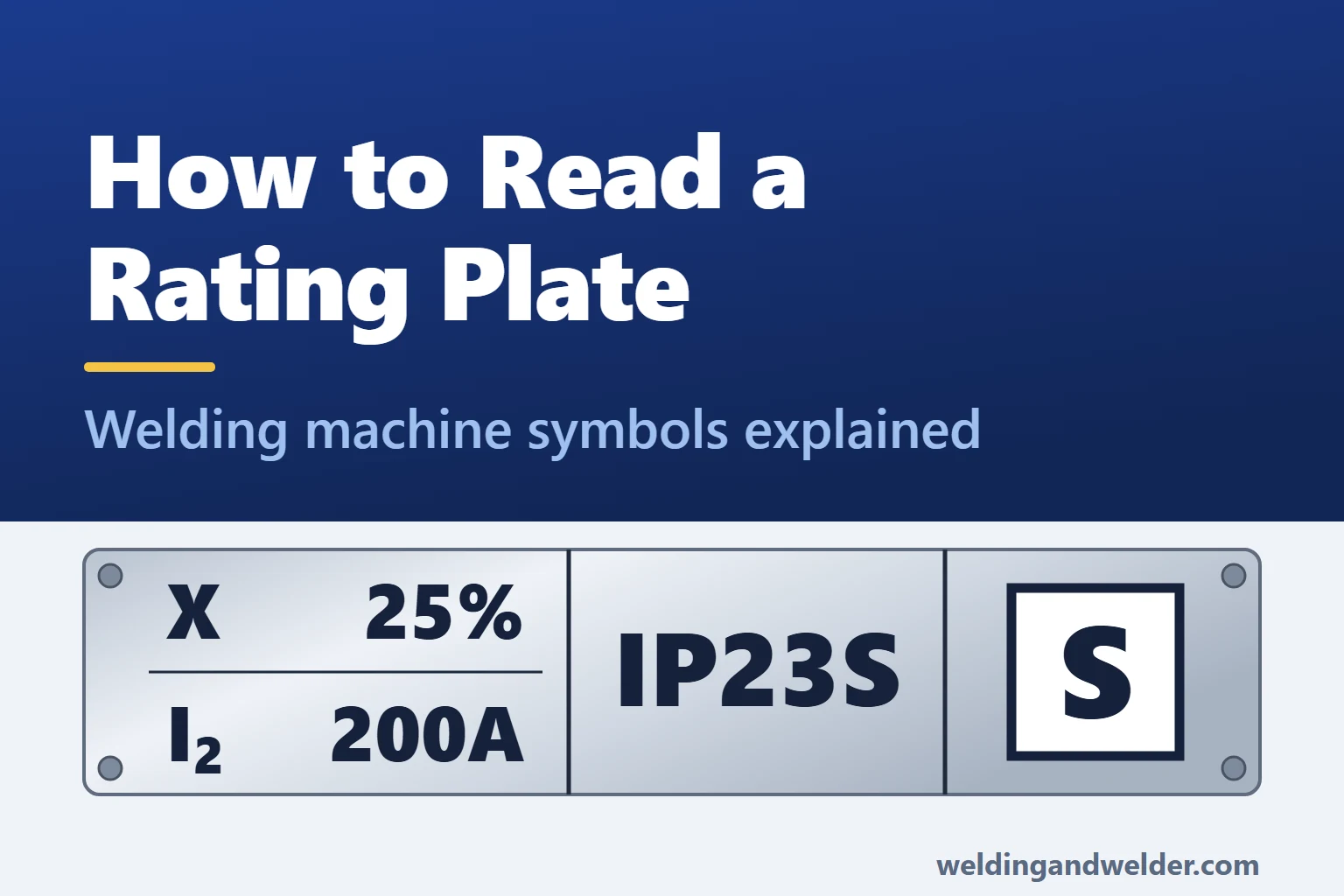
A welding machine’s rating plate tells you how much current it can deliver, for how long, and what supply it needs. It is set out to a standard, so once you can read one you can compare machines from different makers on the same figures.
This guide goes through an example plate marking by marking, then covers the ones that most affect what you buy: duty cycle, input current, IP rating and the S mark.
In this guide:
What Each Marking Means
The numbers match the plate above. Layouts vary between makers, but the main symbols are standard, so this key works on most modern arc welding machines.
| No. | Marking | What it means | What to use it for |
|---|---|---|---|
| 1 | Maker, model, serial number | Identifies the exact machine | Warranty claims, spares and repairs |
| 2 | Machine type symbol | How mains becomes welding current. Here: single phase in, inverter, transformer, rectifier, DC out | Telling an inverter from a transformer, and DC from AC |
| 3 | EN IEC 60974-1 | The standard for arc welding power sources | Knowing the figures were measured in a common way |
| 4 | Process | MIG/MAG, MMA or TIG, each with its own block of figures. Some plates use a symbol instead of a name | Reading the right block for the work you do |
| 5 | Output range | Minimum and maximum welding current, each with its load voltage | Checking it goes low enough for thin sheet and high enough for plate |
| 6 | U0 | Open circuit voltage: the output voltage when the arc is not lit | MMA arc striking, and electric shock risk |
| 7 | X, I2 and U2 | Duty cycle, the welding current it applies to, and the load voltage at that current | Comparing machines for the work you do |
| 8 | I1max and I1eff | Rated maximum supply current and effective supply current, on the mains side | Checking the supply |
| 9 | U1, phases, Hz | Supply voltage, single phase (1~) or three phase (3~), and frequency | Confirming it will run on the supply you have |
| 10 | IP23S | Protection against solid objects and water | Deciding where the machine can stand |
| 11 | S in a square | Meets the requirements for welding where the risk of electric shock is increased | Confined, damp or all-metal work areas |
| 12 | Insulation class, UKCA, CE | Temperature rating of the windings, and the conformity marks | Confirming it carries the marks needed for sale here |
An easy way to remember the numbers: 1 is the mains side and 2 is the welding side. U is voltage and I is current. So U1 is mains voltage and I2 is welding current.
Duty Cycle: X, I2 and U2
X is the percentage of a ten minute period the machine can weld at the current printed beneath it. Read the table in columns. On the example plate, 25% sits above 200 A, so the machine can weld for two and a half minutes in every ten at 200 amps.
The 100% column is the current rated for continuous output, which makes it the most useful figure for production work. In this example, the power source is rated for continuous output at 100 A under the specified test conditions.
Duty cycle under EN 60974-1 is rated at 40°C. The load voltage, U2, comes from a fixed formula for each process, so it shows how the machine was tested. It is not a setting to copy.
For how much duty cycle different types of work need, see amperage and duty cycle in our machine guide.
How to Compare Two Machines
Headline figures can hide the difference that matters. Take two 200 amp machines, made up for illustration:
| Machine A | Machine B | |
|---|---|---|
| Headline | 200 A at 25% | 200 A at 20% |
| 60% column | 130 A | 140 A |
| 100% column | 100 A | 115 A |
Machine A has the better headline. Machine B holds more current for longer, so it suits steady work at 110 amps. Find the current you weld at, and compare there.
Input Current: I1max and I1eff
I1max is the rated maximum supply current. I1eff is the maximum effective supply current, which takes the duty cycle into account. Both are RMS values on the mains side, and I1max is not the brief inrush when the machine is switched on.
A useful approximation is I1eff ≈ I1max × √X, with X as a decimal, but use the manufacturer’s declared I1eff when checking supply requirements. On the example plate that is 31 × √0.25 = 15.5 A. The shortcut ignores the current drawn between welds, and assumes the highest effective current occurs at maximum output, which is not always the case.
A Real Example
The manual for the GYS Easymig 160 (GYS document C51353, version 11, 4 November 2022, page 80) lists these figures:
| Marking | Easymig 160 | What it tells you |
|---|---|---|
| U1 | 230 V ±15%, single phase | Runs on a single phase supply |
| Duty cycle at maximum | 160 A at 20% (MIG) | Two minutes in ten at full output |
| I1max | 30.3 A | Rated maximum supply current |
| I1eff | 13.5 A | Declared effective supply current. The approximation gives 30.3 × √0.20 = 13.6 A |
| Fuse | 16 A | The protection the maker specifies |
| IP rating | IP21 | Protected against vertical drips only, so keep it under cover |
The rated maximum supply current is more than double the effective figure, and the maker still specifies a 16 A fuse. Neither number should be read alone.
- Follow the fuse or breaker rating in the manual first.
- Compare I1eff with your supply, and check the manual for the plug, fuse and cable the maker specifies. On the example plate, 15.5 A is above what a 13 A plug is rated for.
- If the breaker trips, check the manual’s supply requirements and ask an electrician.
- Ask a qualified electrician before changing a plug, breaker or socket.
Typical supplies by machine size are in power supply and machine limits.
U0: Open Circuit Voltage
U0 is the voltage at the output when the machine is on and the arc is not lit. It matters most for MMA, because some electrodes need a higher open circuit voltage. TWI says cellulosic electrodes need around 70 volts, and that on AC some electrodes, particularly basic types, may need 70 to 80 volts. The example plate is DC at 62 V, so it would fall short of the cellulosic figure. Check the electrode packet or datasheet for the figure that applies.
It is also a safety figure, because an MMA holder is normally live whenever the machine is on. Some plates and manuals also list Ur, the rated reduced open circuit voltage, which means the machine has a voltage reduction device (VRD). The Jasic JEV-200DP manual, for example, lists 77 V reduced to 13.8 V.
IP23S and the S Mark
These look alike and mean different things. The S at the end of IP23S is about a water test. The S in a square is about electric shock. A machine can have one without the other.
What IP23S Means on a Welder
| Part | Meaning |
|---|---|
| 2 | Protected against fingers and solid objects of 12.5 mm and over |
| 3 | Protected against spraying water up to 60 degrees from vertical. A 1 here, as in IP21, means vertical drips only |
| S | The water test was done with moving parts, such as the cooling fan, stationary |
So IP23S does not show that the machine can run in the rain. Keep it under cover while welding, and check the manual for the maker’s limits on outdoor use. For site work, choose IP23 or IP23S over IP21.
What the S in a Square Means
The S mark indicates that the power source meets the requirements for welding in environments with increased risk of electric shock, such as confined spaces, damp areas, or inside a metal structure.
It covers the welding, and not where the machine stands. GYS manuals say an S-marked machine should not itself be placed in that environment. Keep the power source outside and run the leads in.
The mark does not make the job safe by itself. HSE says an insulating mat or dry platform may be needed, along with dry gloves and overalls. For MMA it recommends a set with an open circuit voltage limiting device.
Machine Symbol, Insulation Class and Conformity Marks
- Machine type symbol. Reads from mains to output. The box marked f1 and f2 is the frequency converter that makes it an inverter. The overlapping circles are the transformer, and the arrow and bar is the rectifier. A solid line over a dashed line is DC, and a wave is AC.
- Insulation class. The maximum operating temperature of the insulation on the windings. Class B is 130°C, F is 155°C and H is 180°C. It does not measure weld performance, so use the duty cycle to compare machines.
- UKCA and CE. For electrical equipment, GOV.UK guidance accepts either mark in Great Britain. Northern Ireland needs CE, or CE with UKNI.
Checking a Plate Before You Buy
- Process: is there a block for the process you use?
- Current: does the output range go low enough and high enough?
- Duty cycle: what percentage does it hold at the current you weld at?
- Supply: do U1, the phases and I1eff match your supply, and what fuse does the manual specify?
- Location: is the IP rating right for where it will stand, and do you need the S mark?
👉 Compare MIG welders, TIG welders, MMA welders and multi-process machines, or tell our team what is on your plate and we will help you read it.
Rating Plate FAQ
What do the symbols on a welding machine mean?
They describe the machine’s output, supply and protection. U1 and I1 are mains voltage and current, U2 and I2 are welding voltage and current, U0 is open circuit voltage and X is duty cycle. The IP code covers solids and water, and an S in a square means it is suitable for welding where the risk of electric shock is increased.
What does X mean on a welder rating plate?
X is the duty cycle: the percentage of a ten minute period the machine can weld at the current shown with it. 25% at 200 A means two and a half minutes of welding in every ten at 200 amps.
What is the difference between I1max and I1eff?
I1max is the rated maximum supply current. I1eff is the maximum effective supply current, which takes the duty cycle into account, so it is usually much lower. Compare I1eff with your supply, and check the manual for the plug, fuse and cable the maker specifies.
What does IP23S mean on a welder?
The 2 means it is protected against solid objects of 12.5 mm and over, and the 3 means spraying water up to 60 degrees from vertical. The S means the water test was done with moving parts such as the fan stationary, so it does not show the machine can be run in the rain.
What does the S mark on a welder mean?
An S in a square means the power source meets the requirements for welding in environments with increased risk of electric shock, such as confined, damp or all-metal areas. The machine itself should stay outside that area.
Can I run a welder from a 13 amp plug if I1eff is under 13 A?
Only if the maker allows it. I1max can be far higher than I1eff, and the manual may call for a 16 A supply. Check the specified fuse and ask an electrician if you are unsure.
Where is the rating plate on a welder?
Usually on the back, side or underside of the case. If it is missing or unreadable, most of the same figures are normally in the technical specification in the manual.