Welding PPE provides the final layer of protection against risks that remain after other controls are in place. To do that effectively, each item needs to suit the job, fit the person wearing it and remain in good condition. Choosing the right equipment is therefore only part of the task; how it is worn and maintained matters just as much.
This guide takes you through an employer’s PPE responsibilities in the UK, the standards you will encounter and the practical checks to make before welding begins.
In this guide:
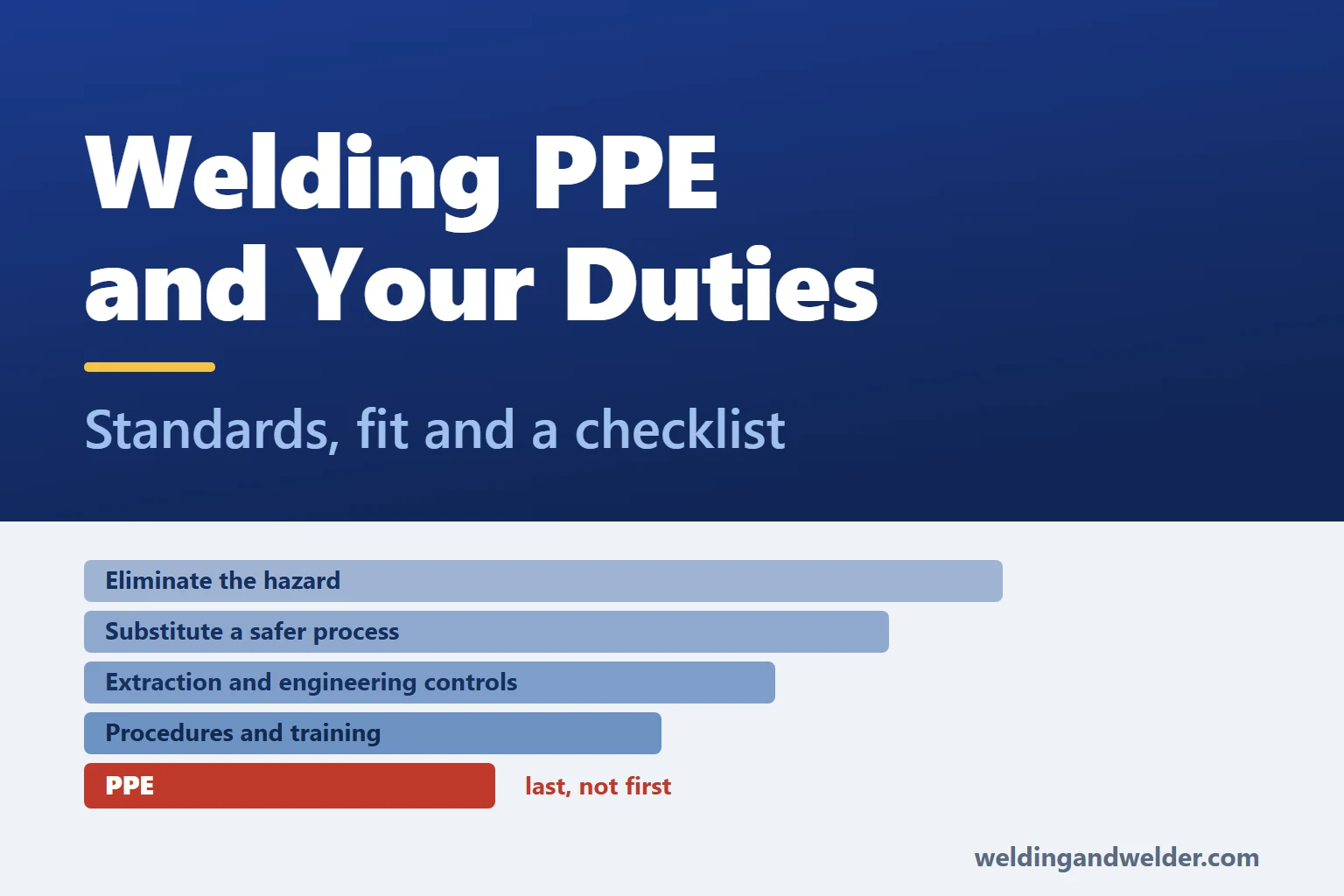
PPE Is the Last Control, Not the First
The hierarchy of control puts PPE last because it depends on the individual wearing and using it correctly. A poor fit or damaged component can reduce protection without being obvious. Measures that remove the hazard or control it at source can also protect other people in the area, which is why they need to be considered before relying on personal equipment.
Welding fume is a useful example. Capturing it with local exhaust ventilation (LEV) helps protect both the welder and people nearby, while a respirator protects its wearer. Use suitable extraction where reasonably practicable, with respiratory protective equipment (RPE) where further protection is needed. Our guide to COSHH duties and LEV explains how to choose the controls for the work being done.
Your Duties in the UK
In Great Britain, the Personal Protective Equipment at Work Regulations 1992 were amended in 2022 to extend duties beyond employees to certain other workers, known as limb (b) workers. Northern Ireland has corresponding regulations from 1993, amended in 2024. Check who falls within the relevant definition rather than assuming everyone working on site has the same legal status. Fume and noise protection also fall under their own specific regulations.
- Provide required PPE free of charge. Employers cannot ask workers covered by the duty to pay for it or recover its cost through deductions from wages.
- Choose PPE for the risks of the job. Assess the work before selecting equipment, as a standard kit may not suit every task.
- Make sure it fits the individual. Correct fit is part of providing suitable PPE and affects how well it protects the wearer.
- Maintain, store and replace it as needed. Equipment must remain serviceable throughout its use, with suitable storage when it is put away.
- Train people to use it correctly. They need to understand why each item is required, how to wear it and where its protection ends.
- Check items together when they are worn together. A welding helmet, for example, must not interfere with the seal or fit of a respirator.
PPE by Hazard
Start by identifying the hazards created by the work, then use the table to match each one to the protection it needs.
| Hazard | What it does | What protects against it |
|---|---|---|
| Ultraviolet and infrared radiation | Arc eye, skin burns and possible long-term skin damage | A suitable welding filter, full face protection and clothing that covers exposed skin |
| Spatter and hot metal | Burns, fires and damage to ordinary clothing | Clothing to EN ISO 11611, suitable welding gloves, aprons and spats |
| Fume and gases | Respiratory disease; welding fume can cause cancer | Suitable extraction and RPE as required by the assessment; face fit testing for tight-fitting RPE |
| Grinding debris and flying particles | Eye injury | Eye and face protection with suitable impact ratings; check certification such as EN ISO 16321-1 or older EN 166 markings |
| Noise | Hearing damage from welding, associated tasks and nearby work | Noise controls and hearing protection matched to the assessed exposure |
| Hot work and heat | Burns from hot material and radiant heat, and the risk of heat stress | Suitable heat-resistant gloves and clothing; reflective protection where needed. PPE alone does not control heat stress |
Head, Eyes and Face
- Choose suitable welding eye and face protection. EN ISO 16321-1 sets general requirements, with EN ISO 16321-2 covering welding. Older product documentation may refer to EN 175 for helmets, EN 379 for auto-darkening filters and EN 169 for fixed-shade filters. Check the product’s certification and intended use rather than relying on a standard number alone.
- Match the filter shade to the process and current. A shade that is too light provides insufficient reduction of visible light. Our lens shade chart helps you choose by process and amperage.
- Wear safety glasses under the helmet. They keep your eyes protected when you lift it for tasks such as chipping and inspection. Grinding also needs suitable face protection for the debris it produces.
- Gas welding and cutting generally use lighter filter shades than arc welding. Choose suitable goggles and any additional face protection needed for the task.
- Use suitable caps and balaclavas to protect the hair and neck from spatter, paying particular attention to coverage when welding overhead.
You can explore the options in our ranges of welding helmets, goggles and spectacles, and caps and balaclavas.
Lungs and Respiratory Protection
The cancer risk from welding fume, including mild steel fume, prompted HSE’s safety alert in 2019. Use extraction for indoor welding where reasonably practicable and add suitable RPE where control remains inadequate. HSE allows a limited exception for occasional welding carried out less than once a week and lasting less than 1 hour, with suitable RPE and effective general ventilation. The assessment must also account for people nearby; a short job does not remove the need to control exposure.
- Arrange face fit testing for tight-fitting respirators. The test must cover the individual wearer and the particular make, model and size they will use.
- Keep facial hair clear of a tight-fitting seal. Where a beard prevents that, choose a suitable loose-fitting powered or supplied-air system; tightening the straps will not solve the problem.
- Integrated respiratory welding helmets combine eye, face and breathing protection, avoiding interference between separate items. A powered filtering helmet draws from the surrounding air and must not be used in an oxygen-deficient atmosphere. Confined-space work needs a separate assessment, safe working arrangements and any specialist breathing equipment that assessment requires.
- Follow the filter replacement instructions. Filters have a limited service life, and appearance alone cannot establish whether one still provides the protection needed.
For equipment options, see our respirator masks; the guides to fume extractors and COSHH and LEV duties explain how respiratory protection fits into the wider control measures.
Hands: Type A or Type B
EN 12477 divides welding gloves into Type A and Type B, reflecting the balance between protection and freedom of movement. Understanding that difference helps you choose a glove that protects your hands while allowing the control the process needs.
| Type A | Type B | |
|---|---|---|
| Priority | Higher minimum requirements for several heat and mechanical hazards | Greater dexterity for precise work |
| Suits | Commonly MMA, MIG and MAG; check suitability for heavier work and gouging | Commonly TIG, where control of the filler rod matters |
| Trade-off | Usually bulkier, with less feel | Lower minimum protection for some hazards; check suitability before using for heavier work |
A lightweight Type B TIG glove may not provide enough protection for heavy MMA work, while a bulky Type A gauntlet can make fine control of the TIG filler rod more difficult. If you regularly do both, keep suitable gloves for each task and check the individual product’s ratings. Our welding gloves range includes options for different processes.
Body and Clothing
When choosing welding clothing, look for EN ISO 11611 and the protection class. Class 1 covers less hazardous welding conditions with lower levels of spatter, while Class 2 is intended for more hazardous conditions with higher spatter. You may also see EN ISO 11612, which covers general protection against heat and flame.
- Choose clothing intended for welding. Ordinary polyester and other meltable fabrics can stick to the skin when heated and make burns worse, so check the layers worn underneath as well.
- Keep exposed skin covered. Gaps at the neck, wrists or waist can allow arc radiation to reach the skin and cause burns.
- Close pockets and cuffs, and keep trouser legs over the boot tops. Avoid trouser turn-ups, which can collect spatter, and leave no opening for hot material to fall into the boots.
- Match the clothing to the exposure. Leather can suit heavy work, while appropriately rated flame-resistant fabric is another option. Aprons, capes and sleeves can add protection where needed, but the complete outfit must provide adequate coverage, particularly overhead.
Compare our welding clothing and welding jackets with the coverage and protection your work requires.
Hearing
Consider the noise from the whole job, including welding itself, grinding, gouging, chipping, plasma cutting and nearby work. Choose hearing protection using the assessed exposure rather than how loud the workshop feels. Too much sound reduction can also cause problems if it prevents people hearing warnings or encourages them to remove their protection to communicate. Our hearing protection range covers the available options.
Protecting People Nearby
The welder’s PPE protects the person wearing it, but someone passing the bay can still be exposed to the arc. Include nearby workers and visitors when planning protection, even if they will not be handling the torch.
- Position suitable screens and curtains to protect passers-by and neighbouring work areas from arc radiation, checking for gaps around their edges.
- Use suitable welding blankets to protect surfaces and items below or around the work from the expected spatter and hot metal.
- Account for reflected arc light. Light, shiny surfaces can reflect radiation out of the welding area, so a suitable matt, low-reflectivity finish can help reduce that exposure.
See our welding screens and curtains, along with welding blankets, for protection around the welding area.
Welding PPE Checklist
Make these checks part of the start of each shift, so problems are picked up before welding begins.
| Item | Check |
|---|---|
| Helmet | Shell intact; suitable filter shade for the process and current; cover lens clean and undamaged; headgear adjusted |
| Safety glasses | Suitable impact rating, lenses undamaged and worn under the helmet |
| Respiratory protection | Suitable for the assessed hazards; correct filters within their service limits; tight-fitting equipment face fit tested for the wearer, with no facial hair across its seal |
| Extraction | Working effectively, with the hood positioned to capture fume and filters clear |
| Gloves | Suitable Type A or Type B gloves for the task, dry and free from holes or burn damage |
| Clothing | Suitable EN ISO 11611 clothing; no meltable layers underneath; pockets and cuffs closed; no frayed or oil-soaked areas |
| Feet and legs | Trouser legs over boot tops, with suitable spats where needed against falling spatter |
| Hearing | Protection matched to the assessed noise exposure for the work |
| Around the bay | Screens correctly positioned, suitable blankets in place and combustible materials removed or protected |
If a check reveals a problem, put it right before starting work and take unserviceable PPE out of use. Browse the full safety equipment range, or use the technical enquiry form to tell us about the process, material and working conditions so we can help you identify suitable equipment.
Frequently Asked Questions
What PPE is required for welding?
Choose a welding helmet with a suitable filter shade, safety glasses underneath, gloves that suit the process and clothing rated to EN ISO 11611. Add respiratory and hearing protection where the assessment requires them, with screens to protect people nearby. The complete selection needs to suit the job and work effectively together.
Does an employer have to pay for welding PPE?
Yes. Employers must provide required PPE free of charge to workers covered by the duty, without recovering the cost from wages. Great Britain’s 2022 amendment extended the duties beyond employees to limb (b) workers, with a corresponding extension in Northern Ireland in 2024.
What is the difference between Type A and Type B welding gloves?
EN 12477 distinguishes between gloves that prioritise protection and those that allow greater dexterity. Type A generally suits MMA, MIG and MAG, while Type B commonly suits TIG, where you need fine control of the filler rod. Check the individual product’s ratings: a lightweight TIG glove may be unsuitable for heavy work, while a bulky gauntlet can make precise handling difficult.
Is PPE enough to protect against welding fume?
PPE protects only the wearer, so the assessment must also address fume spreading to others. Use extraction where reasonably practicable and suitable RPE where needed. HSE permits RPE with effective general ventilation for occasional welding carried out less than once a week and lasting less than 1 hour; this is a limited exception, not a general alternative to extraction.
Can you weld with a beard?
A beard prevents a tight-fitting respirator sealing properly wherever hair crosses the seal. Tightening the straps will not restore its protection. A suitable loose-fitting powered or supplied-air system may allow you to keep a beard, provided it is appropriate for the hazards and fits as the manufacturer requires.
Which EN standards apply to welding PPE?
EN ISO 16321-1 covers general eye and face protection, with EN ISO 16321-2 covering welding. Older documentation may show EN 175 for helmets, EN 169 for fixed-shade filters, EN 379 for auto-darkening filters and EN 166 for general eye protection. EN 12477 covers welding gloves, EN ISO 11611 welding clothing and EN ISO 11612 general heat and flame protection. Check the certification and intended use of the actual product.
Do people nearby need protection too?
Yes. Arc radiation can injure people nearby even when they are not welding. Suitable screens and curtains help protect passers-by and adjacent work areas, while low-reflectivity bay finishes help reduce reflected radiation. The protection depends on a suitable layout as well as the equipment chosen.