The right MIG wire needs to suit both the metal you are welding and the conditions the finished joint will face. Everyday mild steel fabrication often presents a straightforward choice. With stainless steel, aluminium and specialist alloys, you need to consider corrosion, temperature and the properties of the finished weld more closely. Understanding the wire classification helps you make that choice.
This guide takes you through the classifications and explains how to use them when choosing between the main wire types. We use the familiar workshop term “MIG wire”, although MIG and MAG are technically different forms of gas metal arc welding (GMAW): MIG uses an inert shielding gas, while MAG uses an active gas or mixture. The guide also includes flux-cored wires, which are often sold alongside MIG wire but use a separate process called flux-cored arc welding (FCAW).
You can browse our MIG welding wire range or use the MIG Wire Finder to narrow the options by material and thickness.
In this guide:
Understanding AWS Welding Wire Codes
The American Welding Society (AWS) classifies welding consumables by properties such as their composition, strength and intended use. To read a code correctly, first establish which wire family it belongs to, because each family has its own specification. For example, ER70S-6 describes a carbon steel wire differently from the way ER4043 describes an aluminium wire, even though both start with ER.
How to Read an AWS Code
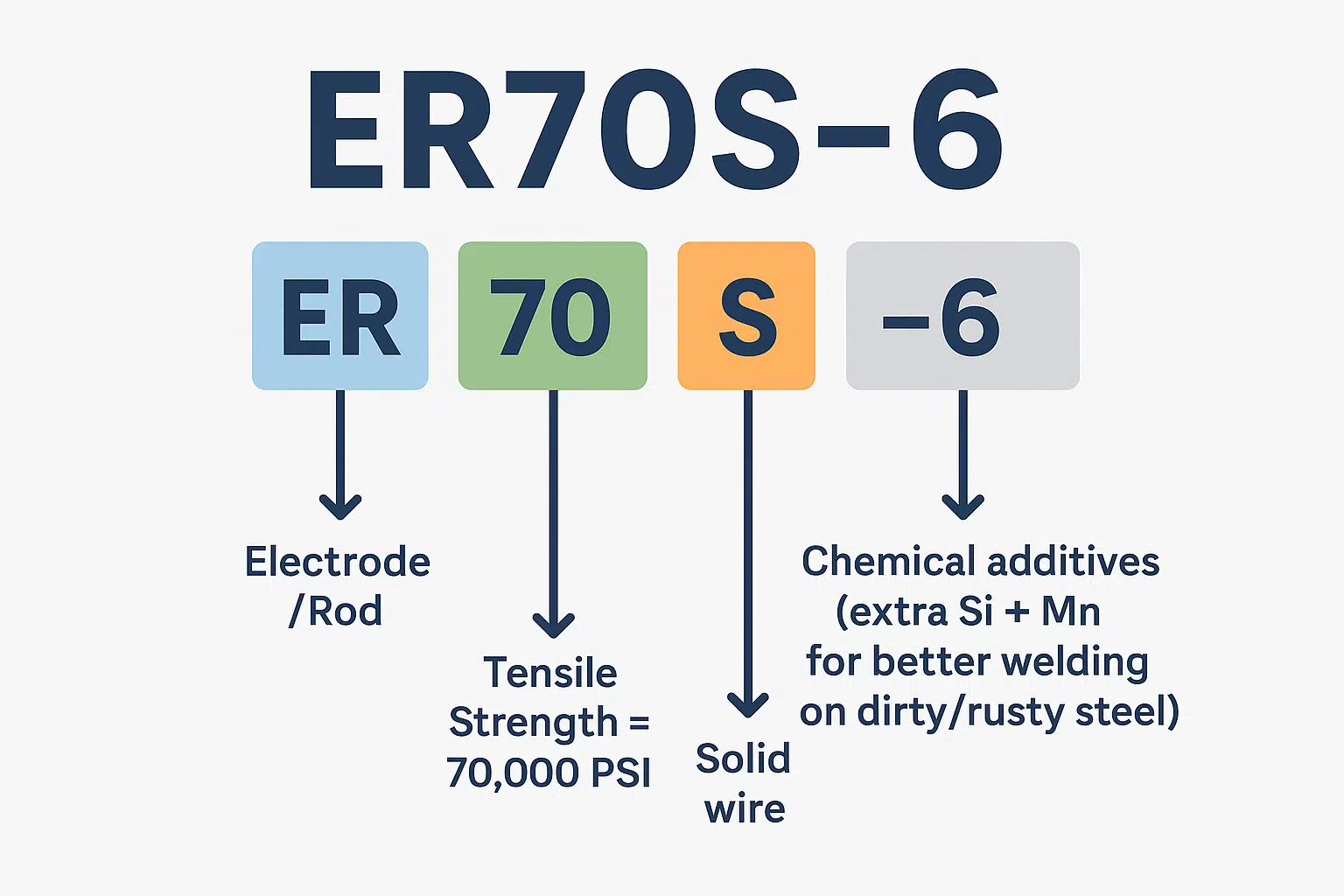
The prefix identifies how the filler is used. E means electrode, with the filler carrying the welding current, while R means a rod added separately, as in TIG welding. ER covers both uses, but the product still needs to be supplied in the right form: a reel for MIG or cut rods for TIG.
In ER70S-6, the 70 is the strength class. Under the classification test conditions, it indicates a minimum weld-metal tensile strength of 70,000 pounds per square inch (psi), or about 480 MPa. The finished joint’s strength also depends on the base metal, joint design and welding procedure. This numbering pattern is used for certain steel wires; numbers such as 308 and 4043 identify alloys instead of strength.
The next letter can describe the wire’s construction. In ER70S-6, S means solid; in E71T-1C, T identifies a tubular electrode; and in E70C-6M, C identifies a composite, metal-cored electrode. Read the letter in its place within the code, as a C at the end of a gas designation means CO2 shielding.
The remaining numbers and letters give more detail about the product. Depending on the specification, they may describe composition, welding position, shielding gas or tested properties such as toughness and hydrogen level. Reading the full code on the reel and data sheet therefore tells you more than a shortened catalogue name.
AWS, EN ISO and UK Trade Codes
In the UK, a reel may show an AWS classification, an EN ISO classification and a familiar trade name such as SG2 or SG3. These can point you towards the right wire family, but they do not always cover exactly the same products: ER70S-6 wires, for example, can carry different EN ISO designations. Use the full classifications and product certificates when deciding whether two reels meet the same requirements, with older names such as A18 serving as a starting point for the search.
Examples
- ER70S-6 is a solid carbon steel wire in the 70,000 psi strength class. Silicon and manganese help control the effects of oxygen in the weld, allowing some tolerance of light surface scale where the joint has been properly prepared.
- ER308LSi is commonly chosen for 304 and 304L stainless steel. Within the code, L means low carbon and Si indicates extra silicon, which helps the molten metal spread along the joint.
- E71T-1C describes a flux-cored carbon steel wire, with 7 indicating the 70,000 psi strength class, the next 1 indicating all-position capability, and T meaning tubular. The -1 identifies a usability group and C specifies CO2 shielding. Use the data sheet for the positions and settings permitted with each wire diameter.
- ER4043 is an aluminium-silicon filler commonly used on compatible 6xxx alloys, including 6061. In this code, 4043 identifies the alloy, rather than a tensile strength.
- ER80S-D2 is a solid low-alloy steel wire in the 80,000 psi strength class. Its manganese and molybdenum additions provide the properties needed for suitable higher-strength steel applications.
Use the code to narrow the choice
Once you know which wire family you need, turn to the product data sheet for the practical details: shielding gas, polarity, diameter and welding position. These must suit the base metal and required weld properties as a combination. Where a welding procedure specification (WPS) applies, it sets the requirements your choice must meet.
Quick Guide: MIG Wire by Material
The table below links each material to a starting choice of wire, with the following sections explaining the differences within each family. Thickness helps determine wire diameter, machine settings, joint preparation and the number of passes, but it cannot establish the correct filler grade on its own.
| Material | Example codes or wire types | Shop the Range |
|---|---|---|
| Mild / Carbon Steel | ER70S-2, ER70S-3, ER70S-6 | Mild Steel (ER70S) |
| High Strength & Low Alloy Steel | ER70S-A1, ER80S-D2, ER80S-G, ER90S-B3, ER100S-G, ER110S-G, ER120S-G | High Strength Steel (ER80S+) |
| Stainless Steel | ER308LSi, ER309LSi, ER310, ER312, ER316LSi, ER347 | Stainless Steel (ER3xx) |
| Duplex & Super Duplex | ER2209, ER2594 | Duplex Stainless (ER2xxx) |
| Aluminium | ER4043, ER4047, ER4145, ER5183, ER5356, ER5554, ER5556 | Aluminium (ER4xxx/5xxx) |
| Flux-Cored & Metal-Cored Steel | E71T-1C, E71T-1M, E71T-GS, E70C-6M | Flux Cored Steel (E7xT) |
| Flux-Cored High Strength Steel | E81T1-Ni1M; weathering grades such as E81T1-W2M | Flux Cored High Strength (E8xT+) |
| Flux-Cored Stainless | E308LT1, E309LT1, E316LT1 families; check the full gas suffix | Flux Cored Stainless (3xxL-T) |
| Nickel Alloys & Cast Iron | ERNiCrMo-3; specialist nickel-iron wire for cast iron | Specialty Alloy (ERNiCrMo) |
| Brazing & Bronze | ERCuSi-A, ERCuAl-A1, ERCu; phosphor bronze wire | Brazing (ERCu) |
| Wear Surfaces | Hardfacing wires, solid and cored | Hard Facing |
Mild Steel MIG Wire (AWS A5.18)
For most everyday mild steel fabrication, ER70S-6 is a useful starting point. Widely used in workshop, vehicle and structural work, it contains silicon and manganese that help it tolerate some light surface scale. Other grades may suit particular preparation or procedure requirements. Within the suitable grades, compare copper-coated and copper-free products by feeding, arc performance and the approvals the job needs.
Browse Mild Steel MIG Wire (ER70S).
| AWS code | Wire composition | Common uses | What to check |
|---|---|---|---|
| ER70S-6 | Carbon steel with silicon and manganese deoxidisers | General mild steel fabrication, including steel with some light surface scale. | Joint cleanliness, shielding gas and required weld properties. |
| ER70S-3 | Carbon steel with lower deoxidiser levels than ER70S-6 | General fabrication on clean steel. | Clean joint preparation; bead shape also depends on gas, settings and technique. |
| ER70S-2 | Carbon steel with aluminium, titanium and zirconium deoxidisers | Specified pipe, tube and fabrication work. | Preparation and process requirements, especially where the steel has a coating. |
If the steel is clean and new, ER70S-3 may also meet the requirements, while ER70S-2 is an option where its particular deoxidising additions suit the procedure. Joint preparation still matters with either grade: remove oil, moisture, heavy rust and loose scale, and give coated steel the preparation and fume controls its coating requires.
Many mild steel wires can use CO2 or an approved argon/CO2 mixture, with the mixture generally producing less spatter. Gas choice also changes metal transfer and weld properties, so it needs to match the wire data sheet and welding procedure as well as give the appearance you want.
When choosing between copper-coated and copper-free versions, compare how reliably they feed and how the arc performs, rather than treating either type as automatically cleaner or better. Copper-free carbon steel wire still has to meet the material and service requirements of the job.
High-Strength and Low-Alloy Steel MIG Wire (AWS A5.28)
Low-alloy steel wires are chosen for the demands placed on the finished joint, which may include high strength, low-temperature toughness or resistance to heat and corrosion. This explains the variety within the group, from structural wires and chrome-moly grades for hot pipework to specialist weathering-steel products. Use the strength number to narrow the options, then look at alloy composition and tested properties to decide which suits the application.
Browse High Strength Steel MIG Wire (ER80S+).
| AWS code | Wire composition | Common uses | What to check |
|---|---|---|---|
| ER70S-A1 | Low-alloy steel with about 0.5% molybdenum | Specified carbon-molybdenum steels in pressure equipment and hot service. | AWS A5.28 classification, base-alloy compatibility, service temperature and heat treatment. |
| ER80S-D2 | Manganese-molybdenum steel | Suitable higher-strength carbon and low-alloy steels. | Required strength, impact toughness and whether the properties are quoted before or after heat treatment. |
| ER80S-G | Composition depends on the product | Specialist low-alloy work; some products are formulated for weathering steel. | The product’s exact composition and approvals, particularly for weathering steel. |
| ER80S-Ni1 | About 1% nickel | Specified low-alloy steels requiring low-temperature toughness. | The impact energy and test temperature on the certificate, plus the job’s acceptance limits. |
| ER80S-Ni2 | About 2% nickel | Specified low-temperature steel applications. | Certified impact-test results against the job’s low-temperature requirements. |
| ER90S-B3 | About 2.25% chromium and 1% molybdenum | Matching chrome-moly steels in power and process equipment. | The required preheat, temperature between passes and post-weld heat treatment. |
| ER100S-G | Manufacturer-defined low-alloy composition | Specified high-strength steel fabrication. | Base-metal compatibility, strength, toughness and hydrogen control. |
| ER110S-G | Manufacturer-defined low-alloy composition | Specified higher-strength steel joints. | The exact product and welding procedure; the strength class alone is insufficient. |
| ER120S-G | Manufacturer-defined low-alloy composition | Specialist high-strength components. | The design requirements, approved filler and heat-control limits. |
Begin with the exact steel grade and the properties the design requires. ER80S-D2 is one option for suitable higher-strength carbon and low-alloy steels, while a -G designation means the individual product’s composition and test results need closer attention. For weathering steel, choose a wire intended for that grade so the weld can meet both the required corrosion performance and appearance.
For low-temperature work, compare Ni1 and Ni2 products using both the energy absorbed in the impact test and the temperature at which it was carried out. The results must meet the job specification; the certificate’s test temperature is not, on its own, an approved operating temperature. Hot-service alloys such as 2.25Cr-1Mo have different needs, with ER90S-B3 used under procedures that control preheat, temperature between passes and any post-weld heat treatment.
The design may call for weld metal that matches the base metal’s strength, exceeds it or falls below it. Following that requirement gives the intended balance of properties, while selecting a higher strength class without a reason can introduce problems without improving the joint.
Stainless Steel MIG Wire (AWS A5.9)
Stainless wire is chosen to give the joint the corrosion resistance and mechanical properties its service requires. Start with the steel grade, then consider the chemicals, chlorides or high temperatures it will face. Within the appropriate filler family, a higher-silicon version such as ER308LSi can make a smooth bead easier to achieve by helping the molten metal spread along the joint.
Browse Stainless Steel MIG Wire (ER3xx).
| AWS code | Wire type | Common uses | What to check |
|---|---|---|---|
| ER308LSi | Low-carbon chromium-nickel stainless | Commonly used for 304 and 304L stainless steel. | Base-metal grade, corrosion requirements and final cleaning. |
| ER309LSi | Higher-alloy chromium-nickel stainless | Many stainless-to-carbon-steel joints and stainless overlays. | How much base metal will mix into the weld, and the service conditions. |
| ER310 | About 25% chromium and 20% nickel | Matching heat-resistant steels, including specified furnace components. | The actual alloy, operating temperature and cracking precautions. |
| ER312 | High-ferrite stainless deposit | Certain dissimilar-steel joints and repair applications. | Known base-metal grades and a repair procedure suited to them. |
| ER316LSi | Low-carbon stainless with molybdenum | Commonly used for 316 and 316L stainless steel. | The actual chemicals, chloride levels and operating temperature. |
| ER347 | Niobium-stabilised stainless | Specified 321 and 347 stainless steel applications. | The stabilised grade and high-temperature service requirements. |
| ER307Si | Manganese-alloyed stainless | Specified dissimilar joints, overlays and repairs. | The manufacturer’s exact classification and recommended base metals. |
For common grades, ER308LSi is often used with 304 or 304L, and ER316LSi with 316 or 316L. The molybdenum in ER316LSi helps with corrosion resistance, although the actual chemicals, chloride levels and operating temperature still determine its suitability. Include final cleaning in your planning, as this also affects the finished stainless joint’s performance.
When joining stainless to carbon steel, ER309LSi is a common choice because the filler must accommodate the base metal that mixes into the weld. ER312 has specialist uses in repairs and dissimilar-metal joints, but those metals still need to be identified before it is selected. For high-temperature work, ER310 and ER347 meet different alloy requirements, so let the base-metal specification and service conditions guide the choice.
Solid stainless wires generally use an argon-based mixture containing a small amount of CO2 or oxygen, sometimes with helium added too. The blend must suit both the wire and the process. Pure CO2 is generally unsuitable for solid stainless wire, although some stainless flux-cored products are designed for it.
Duplex Stainless Welding Wire (AWS A5.9 / A5.22)
Duplex and super duplex stainless steels rely on a balance between two phases, ferrite and austenite, to achieve their strength and corrosion resistance. Both the filler and welding procedure help preserve that balance, particularly for the marine, offshore and chemical service where these steels are used. You can choose between solid and flux-cored products to suit the joint and production needs.
Browse Duplex Stainless MIG Wire (ER2xxx).
| AWS code or family | Wire type | Common uses | What to check |
|---|---|---|---|
| ER2209 | Solid duplex stainless | Commonly used for 2205 and similar 22% chromium duplex grades. | The specified filler, shielding gas and heat-input limits. |
| E2209T | Flux-cored duplex family | Suitable duplex fabrication where a cored wire suits the joint and position. | The complete classification, gas suffix and permitted welding positions. |
| ER2594 | Solid super duplex stainless | Specified 25% chromium super duplex grades. | Base-metal compatibility, corrosion requirements and procedure limits. |
ER2209 is commonly chosen for 2205 duplex, while ER2594 is used with suitable 25% chromium super duplex grades. Where welding position or production speed favours a flux-cored alternative, check that its complete classification, gas requirements and tested properties meet the same requirements for the job.
Once the wire is selected, keep heat input and temperature between passes within the procedure’s limits. Too little heat can alter the final structure as well as too much, so both the lower and upper limits matter to the properties you are trying to achieve.
Aluminium MIG Wire (AWS A5.10)
Aluminium filler selection starts with the exact alloy being welded, then the properties the finished joint needs. Two compatible wires can produce different strength, cracking resistance, anodised colour or performance at temperature. Alongside these differences, consider how the wire will feed: soft aluminium needs suitable drive rolls, a compatible liner and a torch arrangement that supports it properly.
Browse Aluminium MIG Wire (ER4xxx/5xxx).
| AWS code or product designation | Alloy type | Common uses | What to check |
|---|---|---|---|
| 1050 / 1070 | Commercially pure aluminium grades | Suitable commercially pure aluminium joints where corrosion resistance or conductivity matters. | The product’s stated standard and composition; these alloy numbers are not complete AWS codes. |
| ER4043 | Aluminium with about 5% silicon | Many suitable 6xxx alloys, including 6061 and 6063. | Alloy compatibility, required strength and whether the joint will be anodised. |
| ER4047 | Aluminium with about 12% silicon | Specified aluminium joints and compatible casting repairs. | Casting alloy, condition and the proposed repair method. |
| ER4145 | Aluminium-silicon-copper | Specified aluminium alloys and casting repairs. | Compatibility with the particular casting alloy and its service conditions. |
| ER5356 | Aluminium with about 5% magnesium | Many 5xxx alloys and some 6xxx alloys. | Required strength and colour match; generally unsuitable for sustained service above about 65°C. |
| ER5554 | Aluminium with about 3% magnesium | Commonly used with 5454, including suitable elevated-temperature applications. | Compatibility with 5454 and the intended operating temperature. |
| ER5183 | Aluminium-magnesium-manganese | Specified higher-strength joints in alloys such as 5083 and 5456. | Required joint strength and service temperature; generally unsuitable for sustained service above about 65°C. |
| ER5556 | Aluminium-magnesium-manganese | Suitable high-strength 5xxx alloy joints. | Strength, toughness and corrosion requirements; generally unsuitable for sustained service above about 65°C. |
Where the base alloy is compatible with both, the decision often comes down to 4043 or 5356. The more fluid pool from 4043 can help with flow and resistance to certain forms of cracking, while the stiffer 5356 wire generally feeds more easily and can provide higher shear strength. For an anodised part, 5356 often gives a closer colour match and 4043 tends to darken, making a sample worthwhile when appearance matters.
Consider service temperature early, as it can rule out a wire before you compare other properties. Grades such as 5356, 5183 and 5556 are generally unsuitable for sustained service above about 65°C, whereas 5554 is used for suitable elevated-temperature applications with 5454. For higher-strength joints in compatible 5xxx alloys, 5183 and 5556 may be suitable, with the choice based on required properties rather than plate thickness alone.
For casting repairs, identify the alloy and assess the casting’s condition before choosing the filler. ER4047 or ER4145 may suit a particular repair, but trapped gas and contamination can make some die castings difficult to weld.
After choosing the filler, set up the feed system with U-groove drive rolls, an aluminium-compatible liner and the torch arrangement recommended by the equipment maker. A spool gun or push-pull system can help with difficult feeding. Shielding is normally argon or an approved argon/helium mixture; steel-welding gas containing CO2 is unsuitable for aluminium.
Flux-Cored and Metal-Cored Steel Wire (AWS A5.18 / A5.20)
Cored wires offer different ways to improve productivity, especially when welding position or production speed limits what can be done with solid wire. Their cleaning and shielding needs help distinguish the options. Flux-cored products form a slag layer that must be removed, while metal-cored products leave very little slag, though small surface deposits may still need cleaning. Some flux-cored wires provide their own shielding and others require external gas, so consider where the work will be done too.
Browse Flux-Cored Steel MIG Wire (E7xT).
| AWS code | Wire type | Common uses | What to check |
|---|---|---|---|
| E71T-1C | Gas-shielded flux-cored | Suitable structural and general fabrication with CO2 shielding. | Permitted positions, wire diameter, gas and any impact-toughness requirements. |
| E71T-1M | Gas-shielded flux-cored | Suitable fabrication with the specified argon/CO2 mixture. | The specified argon/CO2 blend and preparation needed for any surface coating. |
| E71T-GS | Self-shielded flux-cored | Single-pass light fabrication where the specific product is suitable. | Single-pass restriction, permitted thickness, polarity and application limits. |
| E70C-6M | Gas-shielded metal-cored | Production fabrication and mechanised welding where the process suits the joint. | Gas blend, transfer mode, position and achievable production rate. |
| E71T-1M-H4 | Gas-shielded flux-cored with an H4 designation | Jobs requiring controlled diffusible hydrogen with a suitable wire and procedure. | The required hydrogen limit: AWS H4 and ISO H5 are different designations. |
A suitable gas-shielded flux-cored wire can make vertical or overhead fabrication easier, while metal-cored wire may improve production on joints that suit the process. To judge the benefit, include preparation and cleaning in the comparison. A higher deposition rate only helps productivity if it reduces the time needed to complete an acceptable joint.
Self-shielded wire can be useful outdoors because it does not depend on an external gas shield, but its wind and operating limits still apply. E71T-GS is intended for single-pass work, so follow the manufacturer’s thickness and application limits. Do not use it for multi-pass joints or assume that it is suitable for structural repairs.
Before starting, read the reel label or data sheet for the required polarity. Depending on the product, self-shielded wire may need electrode negative (DCEN) or electrode positive (DCEP), while gas-shielded steel cored wires commonly use DCEP. Keep the wire clean and dry and follow the manufacturer’s handling instructions, especially where the procedure requires controlled hydrogen levels.
Low-Alloy and High-Strength Flux-Cored Wire (AWS A5.29)
Low-alloy flux-cored wires combine the operating characteristics of a cored product with the properties needed for more demanding steel applications. This includes higher-strength structural work, low-temperature service and weathering steel. Products with similar strength numbers can differ in composition and toughness, so use their individual test results and approved applications to make the final choice.
Browse Flux-Cored High Strength MIG Wire (E8xT+).
| AWS code example | Wire type | Common uses | What to check |
|---|---|---|---|
| E81T1-Ni1M | Gas-shielded, nickel-alloyed flux-cored | Specified low-alloy steel work requiring strength and low-temperature toughness. | The full classification, impact-test results, gas blend and welding procedure. |
| E81T1-W2M | Gas-shielded weathering-steel flux-cored | Suitable weathering steel fabrication. | Compatibility with the steel grade and the specified corrosion and mechanical properties. |
For low-temperature work, the impact-test results for a nickel-alloyed product such as E81T1-Ni1M must meet the job specification. For weathering steel, look for a wire intended for the grade and consider corrosion performance and any appearance requirements alongside strength. A Ni1 designation or “Corten” description can help you identify the wire family, with the full classification and certificate establishing what the product can deliver.
Achieving those properties also depends on the way the weld is made. The WPS therefore controls preheat, heat input, temperature between passes, shielding gas and hydrogen levels, with each kept within its specified limits to obtain the performance the filler was chosen for.
Flux-Cored Stainless Steel Wire (AWS A5.22)
Flux-cored stainless wire can be useful when production work or welding position makes a solid wire less convenient. Choose the filler for the stainless grade or dissimilar-metal joint, then check the individual product’s gas and position requirements. Plan for slag removal between passes as well as the final surface treatment the finished joint requires.
Browse Flux-Cored Stainless MIG Wire (3xxL-T).
| AWS code | Wire type | Common uses | What to check |
|---|---|---|---|
| E308LT1-1 / E308LT1-4 | Flux-cored stainless | Commonly used for 304 and 304L stainless steel. | The base grade, shielding gas and permitted welding positions. |
| E309LT1-1 / E309LT1-4 | Flux-cored stainless | Many stainless-to-carbon-steel joints and overlays. | Base-metal mixing in the weld and the service conditions. |
| E316LT1-1 / E316LT1-4 | Flux-cored stainless with molybdenum | Commonly used for 316 and 316L stainless steel. | The actual corrosion conditions and the specified gas. |
The main alloy choices follow a familiar pattern, with E308LT1 products commonly used for 304 and 304L, E316LT1 for 316 and 316L, and E309LT1 for many stainless-to-carbon-steel joints. Where corrosion matters, include the chemicals and operating temperature in the decision as well as the steel grade.
When ordering gas-shielded stainless wire, pay particular attention to the suffix. In the examples above, -1 means CO2 shielding and -4 means an argon/CO2 mixture, so the reel and cylinder need to be compatible. For duplex products, begin with the duplex stainless range, then use each product’s data sheet to confirm its complete classification and gas requirements.
Nickel-Alloy and Cast Iron Welding Wire
Nickel-alloy fillers are used where a joint needs particular corrosion resistance, high-temperature performance or compatibility between different metals. One example is ERNiCrMo-3, commonly called Alloy 625 filler, which is used for suitable alloy joints, overlays and dissimilar-metal work. Nickel-iron wire for cast iron repair has a different purpose, with the casting and repair method guiding its selection.
Browse Specialty Alloy MIG Wire (ERNiCrMo).
| Wire designation | Alloy type | Common uses | What to check |
|---|---|---|---|
| ERNiCrMo-3 | Nickel-chromium-molybdenum, commonly called Alloy 625 filler | Suitable Alloy 625 joints, corrosion-resistant overlays and specified dissimilar-metal joints. | The exact base alloys, service environment and amount of base metal mixed into the weld. |
| Nickel-iron cast iron wire | Product-specific nickel-iron alloy | Approved repairs to suitable grey or ductile iron castings. | A product intended for wire welding, with instructions suited to the particular casting. |
ERNiCrMo-3 can join some combinations of nickel alloys, stainless steel and carbon steel, but the base metal mixed into the weld changes the final deposit. The procedure needs to account for this as well as the materials and service environment, including corrosion or temperature requirements. Because many nickel-alloy weld pools spread less readily than steel, joint preparation and technique must also allow good fusion at the edges.
With cast iron, begin by identifying the casting and choosing a suitable repair method. Some methods use preheat and controlled cooling, while others keep heat input low; bead length and any peening also depend on the method chosen. When ordering, distinguish wire intended for that process from ENiFe-CI, which identifies a covered stick electrode rather than a reel of MIG wire.
MIG Brazing and Copper-Alloy Wire (AWS A5.7)
MIG brazing uses a copper-alloy filler to join the parts while limiting melting of the base metal. On suitable thin or zinc-coated steel, the lower heat can reduce distortion and coating damage, although some zinc will still be affected around the joint. The AWS A5.7 range also includes copper-alloy wires for fusion welding and surfacing, so choose by the intended joining method as well as the alloy name.
Browse Brazing MIG Wire (ERCu).
| AWS code or product designation | Alloy type | Common uses | What to check |
|---|---|---|---|
| ERCuSi-A | Silicon bronze; CuSi3-type products | MIG brazing of suitable steel sheet and other specified joints. | The approved joining method, filler and gas, especially in vehicle repairs. |
| ERCuAl-A1 | Aluminium bronze | Specified bronze repairs, dissimilar joints and surfacing. | Base-alloy compatibility and whether the product is intended for brazing, welding or surfacing. |
| CuSn6P | Phosphor bronze product designation | Suitable bronze repairs and surfacing applications. | The stated AWS or EN ISO classification and the matching base alloy. |
| ERCu | Deoxidised copper | Suitable copper joints and repairs. | Conductivity requirements, shielding gas and heat input for copper welding. |
For vehicle repairs, use MIG brazing only where the manufacturer’s repair method specifies it, following the required filler and joint preparation. CuSi3-type wires are commonly associated with this work. Aluminium bronze and other copper-alloy fillers have particular uses in dissimilar-metal joints, repairs and surfacing, with the base metals and required joint properties determining which combination suits the job.
Pure argon is common for MIG brazing, though some applications call for a specified mixture with a small active-gas addition. Use the filler and equipment guidance to match the gas to the intended process. When planning fume controls, include the coating as well as the base metal and filler, with extraction at source where practicable and suitable respiratory protection where extraction is inadequate or impracticable.
Hardfacing Wire (AWS A5.21)
Hardfacing protects a component with a wear-resistant surface, often after build-up welding has restored metal that has worn away. Begin by identifying what is causing the wear: abrasive particles, repeated impacts, metal-to-metal contact, heat or a combination. Hardness then becomes one part of the choice, alongside toughness, base-metal compatibility and how the deposit will be applied and finished.
Browse Hardfacing MIG Wire.
| Wire type | Deposit properties | Common uses | What to check |
|---|---|---|---|
| Solid hardfacing wire | Hardness and wear resistance depend on the alloy | Suitable shafts, rollers, blades and tooling. | Gas and machine requirements, plus whether the deposit can be machined or needs grinding. |
| Gas-shielded cored hardfacing wire | A wide choice of wear-resistant alloys | Suitable buckets, paddles, wear surfaces and production repairs. | The wear mechanism, deposition rate, position and allowed number of layers. |
| Open-arc chromium-carbide wire | Hard carbide particles in an iron-based deposit | Suitable chutes, augers and other parts exposed to abrasive material. | No external shielding gas; follow the grade’s limits for relief cracks as the deposit cools. |
| Build-up wire | Usually chosen for toughness and support of the surface layer | Restoring dimensions before hardfacing, or serving as a wear surface where suitable. | Base-metal compatibility, permitted build-up thickness and compatibility with any top layer. |
Chromium-carbide deposits often resist abrasive mineral wear well, while a surface exposed to repeated heavy blows needs enough toughness to avoid cracking or breaking away. Consider the loading together with the abrasive material, then use particle size and operating temperature to narrow the choice.
If a part has lost substantial material, a suitable build-up wire can restore its shape before the wear layer is added. Whether it also needs a buffer layer depends on the base metal and surfacing alloy, and each product sets its own limits on deposit thickness and number of layers. Some grades develop fine relief cracks as they cool; these must stay within the permitted deposit and must not extend into the base metal.
Decide how the part will be finished before adding metal, as some deposits can be machined while others need grinding. For bare solid and tubular surfacing products, the relevant AWS specification is A5.21; A5.13 applies to covered stick electrodes.
A good wire choice connects the base metal, the welding process and the demands of the finished job. Establish the alloy and required properties first, then use the classification and product data sheet to confirm the filler, gas, polarity and operating range. Matching these to your machine, joint and any specified welding procedure gives you the information needed for the final choice.
Use the MIG Wire Finder to narrow the options by material and thickness, then compare products in the full MIG welding wire range against the requirements you have established.